



Key Takeaways
- 01 FireFly Metals has made its second significant regional discovery within a month, intersecting 26.7 metres grading 2.3% copper at Nash.
- 02 The company has secured an option to acquire the neighbouring 16.5-square-kilometre Brass Buckle property.
- 03 An updated mineral resource estimate is expected in March 2027, with feasibility work progressing on the proposed Ming Mine production restart.
The discovery, announced on 24 November 2026, lies less than 10 kilometres from the Ming Mine, where FireFly is already studying a return to production.
It is the second significant regional discovery at the FireFly Metals Green Bay Project in a month, following the October results from Mount Joy.
Finding more copper near Ming raises an interesting possibility for the company. Could some of these smaller, surrounding prospects eventually supply material to a central processing facility?
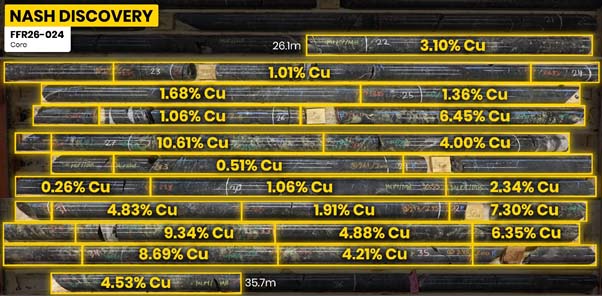
Figure 1: Copper-bearing drill core from hole FFR26-024 at the Nash discovery, showing individual assay grades between 26.1 and 35.7 metres downhole. Image Credit: FireFly Metals, November 2026.
What Are the Latest Copper Drilling Results From FireFly Metals?
The first drilling programme at Nash returned several copper intersections, with hole FFR26-024 producing the standout result.
FireFly recorded 26.7 metres grading 2.3% copper. Within that interval, a 9.6-metre section averaged 4.6% copper.
A subsequent hole drilled to the west-southwest also encountered mineralisation. Further along the same geological trend, drilling at the RDI prospect returned another shallow copper intersection.
| Prospect | Drill Hole | Intersection | Copper Grade | Downhole Start |
| Nash | FFR26-024 | 26.7m | 2.3% | 9.0m |
| Nash | FFR26-024 (included interval) | 9.6m | 4.6% | — |
| Nash | FFR26-036 | 21.3m | 1.2% | 21.7m |
| RDI | FFR26-043 | 11.2m | 1.2% | 15.9m |
Note: Reported drill intersections represent downhole lengths and should not automatically be interpreted as true mineralisation widths.
The shallow starting depths are worth paying attention to. If subsequent drilling establishes sufficient continuity, FireFly could have an opportunity to investigate surface mining alongside its existing underground development plans.
For now, however, the drilling is too preliminary to establish an economically viable open pit.
Following an Electrical Signal Led FireFly to Nash
The discovery traces back to airborne electromagnetic surveys conducted across the district.
An area stretching more than three kilometres caught the exploration team’s attention. Conductive responses of this kind can indicate sulphide mineralisation, although drilling is needed to establish whether valuable metals are present.
FireFly followed up on the survey with geological mapping and rock sampling.
Around 44 rock-chip samples returned copper grades above 1%, with the highest reaching 19.8%.
That last figure needs some context. Rock-chip sampling can pick up particularly mineralised material and does not necessarily reflect the average grade of a deposit.
The drilling and subsequent trenching provide a more substantial basis for further investigation.
Much of the conductive zone remains unexplored.
Could Nash Eventually Supply the Ming Processing Plant?
Distance makes a considerable difference when evaluating smaller mineral deposits.
A standalone mining operation may require its own processing plant, power connection, roads and supporting facilities. For a smaller resource, those expenses can make development difficult to justify.
Nash is close enough to Ming for FireFly to consider a different approach.
Material from regional deposits could potentially be transported to a central processing facility, assuming future studies establish suitable metallurgy, sufficient resources and acceptable transport costs.
The latest Green Bay copper drilling results therefore have significance beyond the grades themselves.
There is still plenty of work between finding mineralisation and putting it through a mill. FireFly must determine how far the copper extends, how consistently it occurs and whether it can be extracted economically.
Brass Buckle Gives FireFly More Ground to Explore
FireFly has also negotiated an exclusive option over the adjoining Brass Buckle property.
The 16.5-square-kilometre land package covers additional ground along the conductive trend associated with Nash and RDI.
One of the RDI intersections was recorded approximately 60 metres from the newly optioned property’s boundary.
Under the agreement, FireFly can acquire full ownership by satisfying several conditions:
- Staged payments totalling C$500,000.
- Minimum exploration expenditure of C$500,000 over three years.
- A 2% net smelter return royalty, with an option to repurchase one percentage point for C$1.5 million.
The distinction here is that FireFly has secured an acquisition option rather than completed an outright purchase.
It now has an opportunity to investigate additional ground where the geological trend continues beyond its existing tenement boundaries.
Resource Growth and Mine Development Are Running in Parallel
Green Bay already has a sizeable mineral resource, independently of the latest Nash discovery.
The August 2026 estimate contained 60.2 million tonnes in the Measured and Indicated categories, grading 2.43% copper equivalent. Another 23.5 million tonnes grading 2.51% copper equivalent sit within the Inferred category.
Earlier this year, Mining Herald covered FireFly Metals’ Green Bay copper-gold expansion and funding programme, following an equity raising of approximately A$180 million.
By the end of September, FireFly reported approximately A$349.7 million in unaudited cash and liquid investments.
Some of that financial capacity is supporting work away from the drill rigs. Camp expansion, site clearing and selected underground development activities have commenced.
Meanwhile, the company is examining an initial mining restart capable of handling 1.8 million tonnes of material annually.
A larger operation remains a possibility under separate studies.
March 2027 Could Bring a Clearer Picture of Green Bay
FireFly has several months of drilling ahead before investors receive the next scheduled resource update.
Six underground rigs are working on the existing Ming resource, while three surface rigs are investigating regional prospects. Further laboratory results from Mount Joy and other targets are still outstanding.
The March 2027 resource update should provide a better indication of how much the drilling has added to the established geological inventory. Feasibility work will address a different question: whether the proposed mining operation makes financial and technical sense.
Nash is still at an early stage. Its proximity to Ming is encouraging, but neither the size of the discovery nor its contribution to future production has been established.
What FireFly has found so far gives its exploration team considerably more ground worth testing.
ALSO READ: Hidden Copper District Value Re-Evaluated: American West Metals’ Drilling Growth
FAQs
Where Is FireFly Metals’ Latest Copper Discovery?
The Nash discovery is located on Newfoundland’s Baie Verte Peninsula in Canada, less than 10 kilometres from the Ming Mine.
How High Were the Copper Grades at Nash?
The strongest reported drill intersection averaged 2.3% copper across 26.7 metres, including a 9.6-metre interval grading 4.6% copper. Selected surface samples reached 19.8% copper.
Has FireFly Metals Started Copper Production at Green Bay?
No. FireFly is progressing exploration, technical studies and early development activities in preparation for a proposed production restart.
When Will FireFly Metals Release Its Next Mineral Resource Estimate?
The company is targeting March 2027 for its next Green Bay mineral resource update.
Could Nash Become an Open-Pit Copper Mine?
Its shallow mineralisation offers grounds for investigating open-pit development. Further drilling, resource estimation and economic studies are required before mining viability can be established.
Disclaimer
This article provides general information and does not constitute financial or investment advice. Exploration results, mineral resource estimates and proposed development scenarios remain subject to geological, technical, financial and regulatory uncertainties. Reported mineral resources should not be interpreted as mineable ore reserves or guaranteed future production.
Filed under

About the author
Jonathon Brown
Jonathon Brown began his career as a broadcaster, working across markets in British Columbia before moving into financial journalism. Since 2017, he has specialised in stock market reporting, covering emerging companies across the healthcare, technology, mining and consumer sectors. He brings more than 15 years' experience to his reporting. A graduate of Vancouver Island University and the British Columbia Institute of Technology, Jonathon is focused on delivering clear, balanced reporting for investors.