






Rio Tinto Bell Bay Aluminium Power Agreement Extends Smelter Life to 2031
Rio Tinto's power deal for Bell Bay was due to expire in December. Two governments have now stepped in to keep the smelter running to 2031.

 Mining news
Market
Leading mining companies and the latest market coverage.
Australia’s mining industry is a cornerstone of the national economy. It not only supports (rather carries) the export industry but also generates employment, alleviates the needs of regional communities, and maintains global supply chains. From iron ore, lithium and other base and battery metals to gold, uranium, rare earths and other critical minerals, Australia has become one of the world’s leading resource jurisdictions.
If you are following ASX market news, stocks & updates, you should know that the importance of the mining sector extends far beyond daily share-price movements. The sector not only extracts the minerals without which a nation cannot thrive, but also provides significant employment opportunities, particularly for people living in rural and regional Australia, making it a backbone of the Australian economy.
Mining plays a colossal role in Australia’s export economy. According to Geoscience Australia, mineral resource exports were worth approximately A$308 billion in 2024. This amounts to 11% of the nation's gross domestic product. So now you know how important the sector is to the nation’s income and economic activity.
Iron ore is the largest contributor, accounting for around 41% of the value of mineral resource exports. Coal (28%) and gold (12%) rank second and third, respectively.
Let’s shed some light on the sector’s influence on the country’s employment. The number of employed individuals in the sector is approximately 314,500 as of February 2026. The median weekly earnings of these people are A$2,832, which is significantly above the all-industries median. Mining employment is also heavily concentrated in regional and remote areas. This makes the sector a very significant economic driver outside Australia’s major cities.
Australia’s resource strength becomes clearer when its production is compared globally.
In 2024, Australia ranked among the world’s top five producers of 14 mineral commodities:
|
Mineral / Metal |
Global Production Rank |
Global Resource (EDR) Rank |
Major Industrial / Technology Use Case |
|
Iron Ore |
#1 |
#1 |
Infrastructure & Steelmaking |
|
Lithium |
#1 |
#2 |
EV Battery Manufacturing |
|
Rutile (Titanium) |
#1 |
#1 |
Aerospace & High-Strength Alloys |
|
Bauxite |
#2 |
#2 |
Aluminium Production |
|
Lead |
#2 |
#1 |
Industrial Batteries & Radiation Shielding |
|
Zircon |
#2 |
#1 |
High-Temperature Ceramics & Glazes |
|
Gold |
#3 |
#1 |
Currency Reserves & Electronics |
|
Rare Earths (REE) |
#3 |
#3 |
Permanent Magnets & Wind Turbines |
|
Zinc |
#3 |
#1 |
Galvanised Steel & Alloys |
|
Manganese Ore |
#3 |
#4 |
Speciality Alloys & EV Batteries |
|
Cobalt |
#4 |
#2 |
Next-Generation Battery Cells |
|
Ilmenite |
#4 |
#1 |
Titanium Pigments & Metal Extraction |
|
Uranium |
#4 |
#1 |
Nuclear Energy Generation |
|
Black Coal |
#5 |
#2 |
Power Generation & Metallurgical Steel Production |
The resources sector is a major focus for the country. Australia is a major global hub for minerals and consistently features high on the priority list whenever the topic “mining” surfaces in any conversation, even in the farthest corners of the world. This page enlists all the updates from Australia’s resources sector. We publish the latest ASX mining news here so that you do not need to hop from site to site to stay in the loop.
Ans: Australia, which has one of the world’s most diverse resource bases, produces a wide range of major commodities, including iron ore, coal, gold, lithium, copper, bauxite, nickel and manganese.
Ans: The critical minerals that are extracted in Australia, which include lithium, rare earth elements, cobalt, manganese, graphite, nickel and titanium-bearing minerals, are very important to the nation’s economy. These critical minerals are essential to two critical aspects of the nation: defence and the clean energy transition.
Ans: Large-cap (BHP, Rio Tinto, Fortescue, etc.), Mid-cap (Sandfire Resources, Pilbara Minerals), and Small-cap (Forrestania Resources, Redstone Resources, Culpeo Minerals) exploration companies.
BHP Group Limited (LSE: BHP) is one of the largest prime diversified resources houses in the world. Global commodity output from its assets include iron ore, copper, metallurgical...
About Evolution Mining Limited (ASX: EVN) describes itself as a premier global gold company. The Company operates six production centres across Australia and Canada. Evolution Mining sits within...
Fortescue Ltd (ASX: FMG) began in 2003 as ten people, a dog, and Andrew Forrest's stubborn conviction that Western Australian iron ore had room for a third major...
If you’ve been keeping tabs on battery metals on the ASX, then odds are IGO Ltd has popped up now and then. Listed on the ASX 100, and...
In recent gold stock news reported by Mining Herald, gold is Newmont's business. Not its only one the company also pulls copper, silver, zinc and lead out of...
About Northern Star Resources Ltd (ASX: NST) mines gold, and only gold, on a global scale. The Company has three main production centres on two continents. Northern Star...
PLS Group Limited (ASX: PLS) is a leading global producer of lithium materials. The Company operates across Australia, Brazil and South Korea. Pilgangoora Operation Pilgangoora Operation is the...
Rio Tinto Share Price & Mining News The 150-year-old giant remaking itself around copper and lithium. Rio Tinto share price and mining news, tracked here. The dual-listed major...
South32 (ASX: S32) is a global mining and metals company, built to create value from commodities that show up in almost every corner of modern life. The business...
Whitehaven Coal ASX: WHC Share & Company News is a service dedicated to one of Australia's biggest coal producers and one of the biggest suppliers of coal to...
Rio Tinto's power deal for Bell Bay was due to expire in December. Two governments have now stepped in to keep the smelter running to 2031.
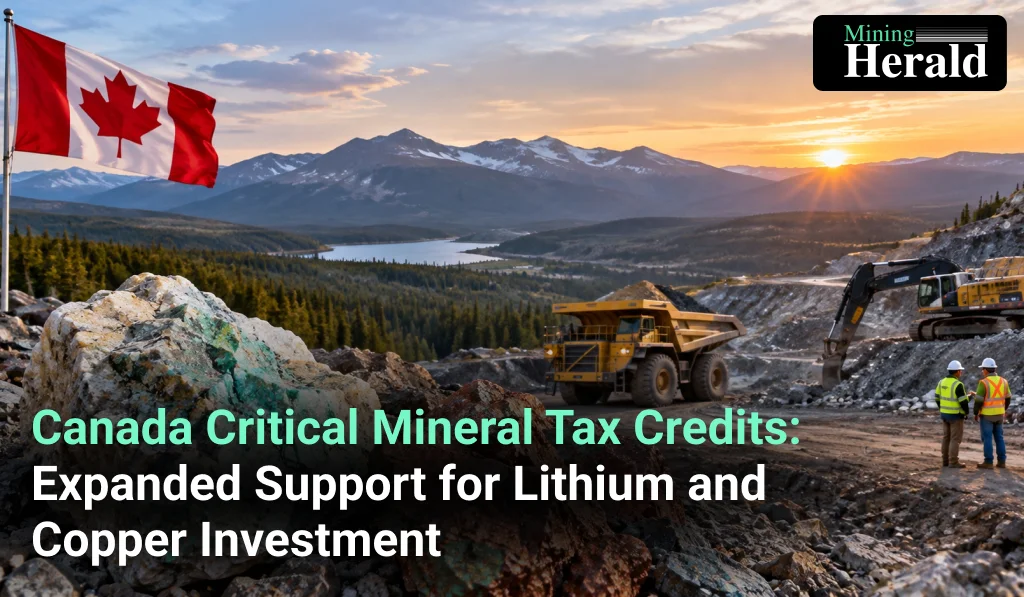
Canada’s exploration incentives offer lithium and copper projects a route to investment by reducing the tax burden on eligible investors who finance qualifying work.
Traditional models insist rising yields should push bullion lower, yet persistent physical accumulation tells an entirely different story. Mounting fiscal deficits and sticky price pressures now firmly reshape the global market trajectory toward 2027