


Key Takeaways
- 01 Capital discipline is reshaping commodity supply curves into 2026.
- 02 AI infrastructure capex is becoming a primary macro variable.
- 03 Central bank policy across AU, CA and US is converging on neutral.
The Nyanzaga Gold Project is moving from construction into commissioning. That changes what shareholders need to watch. Completed structures matter, but the next updates must show how the plant performs with ore and whether the remaining infrastructure is ready. In this article, Mining Herald looks at the first-gold target, the revised funding estimate and the operating checks that come next.
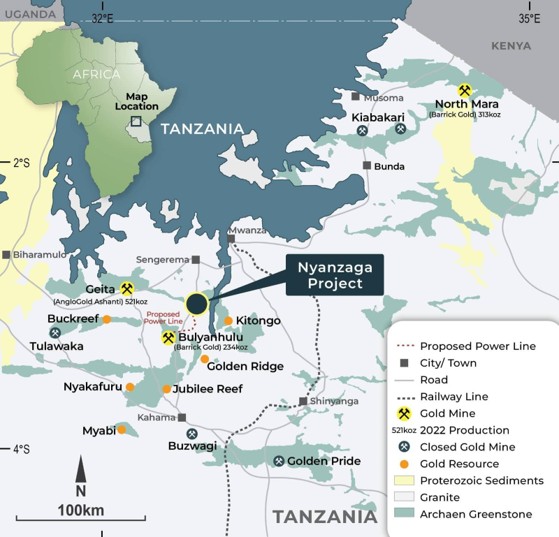
Figure 1: Nyanzaga’s location in Tanzania’s Lake Victoria goldfields. Archive project map; neighbouring mine production labels refer to 2022, and the power line is shown as proposed. Credit: Perseus Mining.
First Ore Moves the Project Into a Different Kind of Testing
The November update reported that ore had entered the processing plant. The tailings facility and camp were complete, and lining of the SAG and ball mills had finished. These are tangible steps towards the early-2027 first-gold target.
There is still a distinction between feeding a plant and operating it consistently. Commissioning tests how individual systems work together. Equipment that performs on its own must also cope with material moving through the full process.
For shareholders following the Perseus Mining Nyanzaga Project, that means the next announcement deserves more than a check of its headline date. Does it describe a completed test, initial gold production or sustained output? Each answers a different question.
The Grid Connection Remains a Near-Term Checkpoint
The 220 kV grid connection was nearing completion in the November report, with commissioning expected later that month. Its timing matters because a processing plant depends on dependable power for milling and other continuous operations.
A connection being physically complete is not the same as one being commissioned and available for use. The useful follow-up is confirmation that the system has passed its tests and can support the operation as intended.
A power delay would not automatically establish a revised first-gold date. It would, however, require shareholders to examine what work can proceed and whether the operating sequence has changed. The company’s next update should provide that evidence.
The Total Funding Estimate Has Changed, Even Though Construction Capital Has Not
The original USD 523 million figure is no longer the full forecast shown in Perseus’ September-quarter report. The distinction is in the pre-production mining allowance, rather than the construction and operational-readiness line.
| Cost category | Original estimate | Latest forecast |
| Construction and readiness | 483 | 483 |
| Pre-production mining | 40 | 70–80 |
| Total | 523 | 553–563 |
All figures are USD millions. The forecast is from the quarter ended 30 September 2026, released on 27 October.
Perseus reported USD 443.9 million in total project spending by quarter-end. That figure includes capital advances and should not be confused with costs recognised as expenses.
The higher pre-production allowance accompanies accelerated mining ahead of first gold. More work before revenue begins raises the cash requirement at that stage, even where the plant construction budget is unchanged.
This is why investors should compare the scope behind two estimates. A larger total can reflect extra or earlier work, higher prices for the same work, or a combination. The labels in the budget explain more than the headline difference alone.
A Larger Reserve Supports the Plan, but Does Not Deliver Annual Output
Nyanzaga sits in north-western Tanzania’s Lake Victoria goldfields. Perseus owns an 80% contributing interest; the Tanzanian government holds a 20% non-contributing interest.
The February 2026 reserve estimate contained 4 million ounces in 90.9 million tonnes grading 1.38 grams per tonne. The mine plan envisages 3.5 million ounces of production over 16 years, including more than 200,000 ounces annually from FY2028 to FY2041.
Those figures describe different things. A reserve is an estimate of economically mineable material under the stated assumptions. Planned production is the amount expected to be recovered over time. Neither is a record of gold already sold.
For readers researching Nyanzaga Gold Mine Tanzania, the annual operating result will eventually provide a more immediate test: tonnes processed, grade, recovery and the cost of producing each ounce. Mining Herald’s guide to gold mining costs, grade and recovery explains why those measures need to be read together.
First Gold Will Begin the Operating Test, Not Finish It
Perseus’ September report targeted January 2027 for first production. That sits within the early-2027 timing described in the November update. The target should remain a target until the company confirms the event.
Even after the first pour, a mine needs time to establish a dependable production rhythm. Short operating runs can demonstrate that the process works without proving the plant can repeat that result throughout a quarter.
Recovery is part of that test. If the plant treats its expected tonnage but recovers a smaller share of the gold, fewer ounces emerge from the same feed. Maintenance interruptions can reduce throughput too. These are operating questions that construction completion alone cannot settle.
The first full reporting periods will therefore matter as much as the opening milestone. Shareholders should look for actual performance against the ramp-up plan, including explanations where output or spending differs from expectations.
Four Updates Will Show Whether the Schedule Is Holding
- Power: confirmation that the grid connection has been commissioned and is available for operations.
- Processing: evidence that commissioning has progressed from initial ore feed to repeatable plant performance.
- Funding: the remaining cash requirement, including pre-production work and any changes to the forecast.
- Production: confirmation of first gold, followed by a clear account of ramp-up and the next output targets.
Nyanzaga is closer to becoming an operating mine. The investment question now moves from what has been built to what that equipment can deliver. The January target provides a useful date to follow; consistent output and cash generation will take longer to demonstrate.
ALSO READ: Why Mining Companies Are Reworking Project Economics Before Committing to Construction
FAQs
When Does Perseus Expect First Gold at Nyanzaga?
The September-quarter report targets January 2027. The November update refers to early 2027. Neither is confirmation that production has begun.
Does First Ore Mean Commercial Production?
No. Feeding ore is a commissioning milestone. It does not establish that the mine has reached a sustained operating rate.
Why Is the Total Forecast Above USD 523 Million?
The pre-production mining allowance has risen to USD 70–80 million. Construction and operational readiness remain at USD 483 million.
Does Perseus Own the Whole Project?
No. Perseus holds an 80% contributing interest, while the Tanzanian government holds a 20% non-contributing interest.
Disclaimer: This article provides general information, not personal financial advice. Production dates, budgets and mine-life estimates are forward-looking company expectations and may change. Project figures are on a whole-project basis unless stated otherwise.
Filed under

About the author
Jonathon Brown
Jonathon Brown began his career as a broadcaster, working across markets in British Columbia before moving into financial journalism. Since 2017, he has specialised in stock market reporting, covering emerging companies across the healthcare, technology, mining and consumer sectors. He brings more than 15 years' experience to his reporting. A graduate of Vancouver Island University and the British Columbia Institute of Technology, Jonathon is focused on delivering clear, balanced reporting for investors.