


Key Takeaways
- 01 Capital discipline is reshaping commodity supply curves into 2026.
- 02 AI infrastructure capex is becoming a primary macro variable.
- 03 Central bank policy across AU, CA and US is converging on neutral.
A mining project feasibility study puts a price on a particular mine design. By the time directors have to approve construction, they may have firm contractor quotes where engineers once used estimates.
They may also have a choice about which facilities to buy, which to lease and which can wait. Each decision changes how much cash the company needs and how soon investors might see it back. Here’s why:
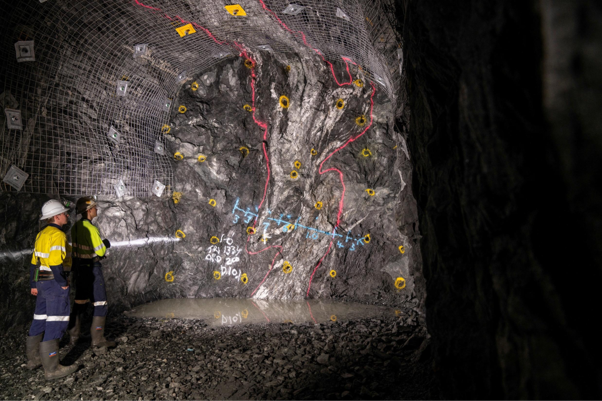
Figure 1: Workers examine a marked underground face at Bellevue Gold in Western Australia. Credit: Bellevue Gold Limited.
A Smaller First-Stage Plant Reduces the Cash Needed Before the First Sale
SolGold’s 2024 Cascabel pre-feasibility study suggested processing 12 million tons of ore a year. It would later be raised to 24 million tons. Mine development cost, the first plant module and supporting infrastructure prior to production is USD 1.55 billion.
Opening bill savings. Shareholders and lenders would not have to put up the full facility until the mine turned a profit. SolGold would start with less processing capacity and would need to finance any expansion.
A board considering those alternatives must consider what the first stage can earn. A smaller start is advantageous if early sales fund the second stage. If early output disappoints, the corporation may need to raise money for expansion when its borrowing position is worst.
Permit Conditions Can Change What a Contractor Has to Build
At Eskay Creek, the estimate reversed. The 2023 definitive feasibility study estimated USD 560 million for the project. Both forecasts contained a USD 35 million contingency.
Development was underway when Skeena altered the value. That makes Eskay Creek a good illustration of approval uncertainty. The updated budget included final permit requirements, impact benefit agreement commitments, engineering changes, inflation, and early construction experience.
Try a water treatment plant. Engineers can budget for treatment equipment before permit requirements are defined. After determining performance and design, a contractor can price installation. Both amounts are on the same budget line, but only the latter tells directors what they are considering.
Leasing Can Lower the Construction Budget While Leaving Bills for Later
Skeena intended to lease water, power and campsite facilities. Solutions save USD 94 million in up-front mining project costs. That cut was reflected in the new $659 million budget. Subtracting it again would underestimate the required need.
This matters in comparing costs for mining projects. Lower construction budgets can get you a better price from suppliers. The corporation may have agreed to pay for the same facility for several years as well. The first one alone reduces the purchase price. The second is adjusted when cash leaves the business.
The timing of mining project financing matters most in the months before sales become dependable. Contractors may be owed money, lease instalments may have begun and the plant may still be working up to its planned output.
Even committed funding can come with conditions on when the company may draw it. The funding terms behind the Prieska copper mine revival illustrate the difference: financing for the first stage was available while a larger tranche for later development remained conditional.
Early Recovery Rates Can Change How Fast Investors Get Their Money Back
A factory can treat the expected tonnage and deliver less metal than budgeted. Take 1 million tons of 1% copper ore. The ore has 10,000 tons of copper. Recovery = 90% = 9,000 tons concentrate. The amount drops to 8,000 tons at 80%. The mine moved the same ore but retrieved 1,000 fewer tons of copper before customer payment conditions.
Also important is the start date. According to Cascabel, processing takes four years to pay off. The wait begins earlier for building shareholders. If the build takes longer than expected, their capital is committed even if the factory reaches production expectations.
| When a Project Update Says… | What to Check |
| Initial capital has fallen | Has equipment become cheaper, or has the company deferred or leased it? |
| Construction costs have risen | Are contractors charging more for the same work, or has the work itself changed? |
| Financing is in place | When can the company draw the funds, and what conditions remain? |
| Payback is expected within four years | Does the clock start at construction approval, first processing or commercial production? |
The most useful comparison before a construction vote is the amount due before the first sale alongside the obligations that survive it. At Cascabel, that means looking beyond the smaller first plant to the cost of expansion.
At Eskay Creek, it means reading the revised construction budget alongside future lease payments. Those figures give shareholders a better view of what the board is being asked to approve.
ALSO READ: Glencore Funding Advances Prieska Copper Revival
FAQs
Do Positive Feasibility Studies Give the Go-Ahead for Construction?
No. An assumption-based analysis is an estimate of expected mine performance. Another move is to invest in construction.
Is Pre-Production Capital the Full Mine Cost?
No. It contains estimated production costs. Running costs are different, replacement of equipment later, growth.
Why Can Budgets with Contingencies Rise?
Contingencies take care of uncertainty. Scope and new budget can be affected by a new permit requirement or design change.
What Should Investors Compare between Two Study Versions?
Start with plant capacity, construction scope, and production start date. Check the funding needed for leases and expansion. That reveals whether the corporation cut costs or transferred them to another year.
Disclaimer: This article provides general information, not financial advice. Study estimates are dated projections. The copper recovery example is illustrative and does not represent either project’s operating results.
Filed under

About the author
Jonathon Brown
Jonathon Brown began his career as a broadcaster, working across markets in British Columbia before moving into financial journalism. Since 2017, he has specialised in stock market reporting, covering emerging companies across the healthcare, technology, mining and consumer sectors. He brings more than 15 years' experience to his reporting. A graduate of Vancouver Island University and the British Columbia Institute of Technology, Jonathon is focused on delivering clear, balanced reporting for investors.