

Key Takeaways
- 01 Capital discipline is reshaping commodity supply curves into 2026.
- 02 AI infrastructure capex is becoming a primary macro variable.
- 03 Central bank policy across AU, CA and US is converging on neutral.
The world is ditching oil and gas. Solar panels are going up, EV sales are climbing, wind farms are expanding offshore – and every single one of these technologies runs on minerals pulled out of the ground, such as Lithium, Copper, Cobalt, Nickel, Graphite, and Rare earths.
Here’s the uncomfortable truth nobody leads with: the global energy transition has a raw materials problem. And the data coming out in 2026 from the IEA and J.P. Morgan Research shows it’s getting more serious, not less.
Demand Numbers That Should Get Your Attention
The scale of what’s being asked of these minerals is genuinely staggering when you look at the actual figures.
In 2024, lithium demand jumped by nearly 30% – far beyond the 10% annual growth that was considered strong through the 2010s. Nickel, cobalt, graphite, and rare earth elements each grew 6–8%, almost entirely driven by energy applications: EVs, battery storage, renewables, and grid expansion.
That pace isn’t slowing down in 2026. According to J.P. Morgan Global Research:
- Lithium demand is forecast to grow 16% year-over-year in 2026, with 58% of that growth coming from electric vehicles and 30% from energy storage systems
- Global copper demand is expected to grow 2.6% YOY, with tight supply and shrinking inventories keeping the market under pressure
Zoom out to 2040, and the IEA’s projections put the scale of this challenge in full relief:
- Lithium demand grows fivefold from today’s levels
- Graphite and nickel demand roughly double
- Cobalt and rare earth elements grow 50–60%
- Copper, already the largest mineral market, grows 30% by 2040
These aren’t fringe projections. They’re the conservative, “stated policies” scenario – what happens if countries just follow through on what they’ve already announced.
 Lithium supply gaps widen sharply as 2035 demand outpaces projects. [Courtesy: IEA]
The Supply Problem Nobody Has Solved
More demand would be fine if supply were spread broadly around the world. It isn’t – not even close.
The following picture of the concentration of production is stark in the 2026 report:
- Cobalt: The Democratic Republic of Congo produces almost three-quarters of the world’s cobalt.
- Nickel: Indonesia and the Philippines make up over 2/3 of the world’s nickel production.
- Lithium: Over 50% of the world’s supply is in Australia and Chile.
- Rare earths: China accounts for roughly 70% of mining and over 85% of refining and separation capacity
And if anything, the refining side is worse than the mining side. In 2024, the top three refining countries’ market share for all these products increased to 86% from 82% in 2020, with nearly all the growth attributable to one country each, namely Indonesia for nickel and China for all others.
In practice, project timelines for clean energy projects are delayed by a single export ban, a single political dispute, and a single natural disaster in the wrong country.
 Few countries hold the keys to the world’s mineral wealth. [Courtesy: UNCTAD]
The Value Gap Most Countries Are Missing
Here’s a dimension of this story that rarely gets the attention it deserves. The big money in critical minerals isn’t in digging them up – it’s in what happens next.
The prices of refined materials such as lithium, graphite, nickel, and cobalt were 3 to 4 times that of their raw, unpurified counterparts in 2022. The price of refined cobalt averaged $20.8 per kg, while the price of raw cobalt was only $6.6 per kg.
Countries that sell raw ore without processing are really selling most of the value of the raw ore. The report convincingly urges countries going to the refining and downstream manufacturing/downstream processing industry to develop greater and more resilient economies and to limit their dependence on commodity markets. It is not only geology that dictates who is the “winner” in a minerals boom.
Recycling: The Missing Piece
You’d think recycling would be filling some of this supply gap by now. It isn’t.
Out of 26 materials needed for the energy transition, 7 have end-of-life recycling rates of just 1–5%, and 10 – including lithium, gallium, and silicon metal – are not recycled at all.
For lithium specifically, this matters a great deal. The IEA projects the market flipping into deficit territory in the 2030s unless both new mine development and recycling infrastructure scale up significantly – and right now, only one of those two levers is getting serious investment.
The Investment Gap Is Massive
Political commitments to clean energy are one thing. The actual capital needed to back them up is another.
The industry will need approximately 80 new copper mines, 70 new lithium mines, 70 new nickel mines, and 30 new cobalt mines in order to meet the 2030 net-zero goals. The investment needed from 2022 to 2030 is projected to be in the range of $360 billion to $450 billion, a $180–$270 billion deficit. The largest proportions of that gap are made up of copper and nickel, which make up 36% and 16% respectively.
It’s not a rounding error; that’s a high price to pay. Projects that should be ready for development now continue to await permits, capital, and basic infrastructure. Each year of delay will increase the supply crunch in the 2030s.
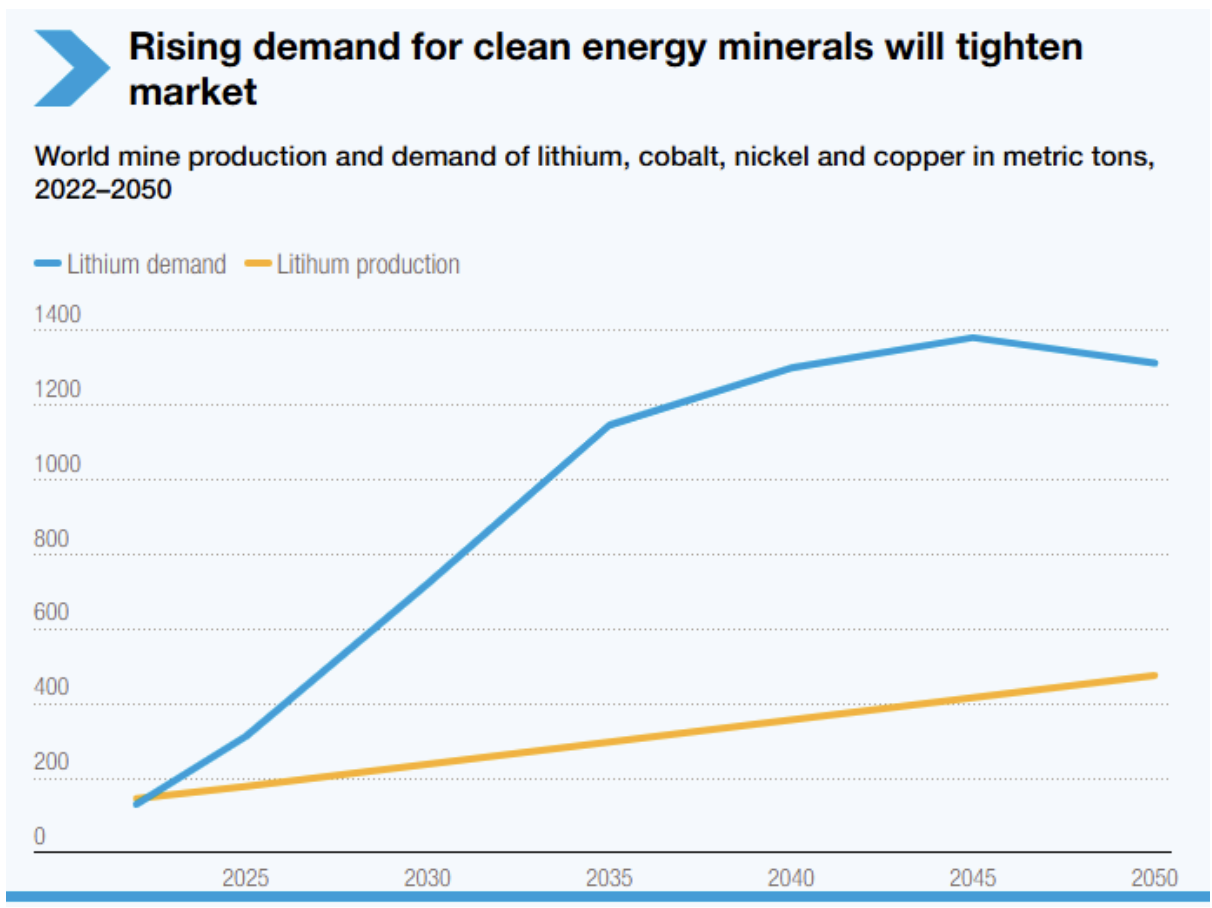 Lithium Demand vs Lithium Production. [Courtesy: UNCTAD]
But why is 2026 a turning point?
It is becoming apparent in 2026 that demand for critical minerals is not solely powered by a single engine. EVs used to drive almost all of the growth story. Now, grid modernization, battery energy storage systems, and the surging power needs of AI data centers are adding entirely new layers of demand – shifting the mineral cycle away from consumer product sales and toward broad infrastructure investment.
The renewable energy sector is entering a more difficult industrial phase, where refining capacity, export controls, and equipment bottlenecks are increasingly deciding whether projects actually get built. Critical minerals have become as important to energy project delivery as capital itself.
The countries and companies that get ahead of this – through supply diversification, domestic processing investment, and recycling infrastructure – will have a serious advantage. Those that don’t will be building the clean energy future on a very shaky foundation.
Frequently Asked Questions
Q1. What are critical minerals, and why are they considered “critical”?
A1. The minerals are contained within all of EV batteries, solar panels, and wind turbines! It is clear that without them, clean energy doesn’t work. They are considered “critical” because when supply is cut off, due to a war, a trade ban, or the closure of a mine, whole industries come to a standstill.
Q2. What are the critical minerals for Energy Transition?
A2. Batteries contain lithium and graphite. All the electrical and grid systems of the world are connected by copper. Nickel and cobalt fine-tune battery performance. Rare earths are used to drive electric vehicles and wind turbines. If any of these factors drop out, then the clean energy transition slows down.
Q3. What is the reason for China’s domination of the processing?
A3. Simply, they came in, and they put a lot of money in when no one else did. When the Western governments realized the importance of refining capacity, China had already done so. It’s a 20-year head start, and it’s not going away overnight.
Q4. Does recycling offer a solution to the supply issue?
A4. Eventually, maybe. But right now? Of all the ten transition minerals, lithium has a recycling rate of (literally) zero. The technology and collection infrastructure are not ready. Long-term, it’s a good bet, but not this decade. European Court of Auditors
Q5. Does the developing world benefit from its mineral resources?
A5. Many are not, and that’s the part that is frustrating. Nations exporting unprocessed ore are giving away the bulk of its value to those who will refine it; refined cobalt is $20.8 per kg, whereas the raw version is $6.6 per kg. If they don’t have the processing capacity here, the wealth remains on paper.
Filed under

About the author
Plamen Vasilev
Plamen Vasilev is a writer and language specialist with over 6 years of experience developing informative and engaging content across multiple industries. He combines strong research skills with a deep understanding of finance, mining, technology, and business topics to create well-crafted articles that connect with readers.