

Key Takeaways
- 01 Capital discipline is reshaping commodity supply curves into 2026.
- 02 AI infrastructure capex is becoming a primary macro variable.
- 03 Central bank policy across AU, CA and US is converging on neutral.
Australia’s iron ore exports earned A$127 billion in 24 The national resources report records historical export value, but does not determine whether a particular mine has spare rail or shipping capacity. The question requires a step-by-step evaluation.
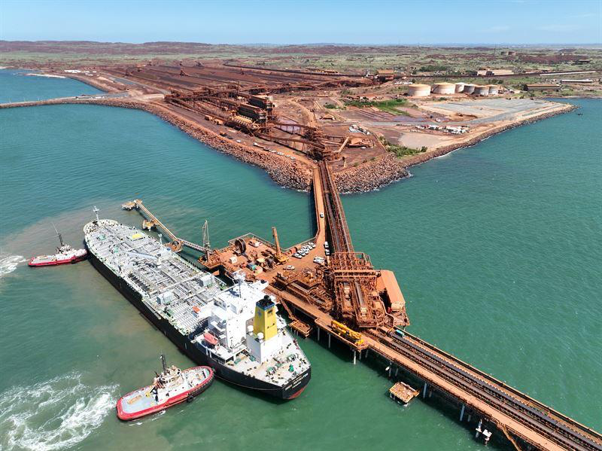
Figure 1: An empty Fortescue iron ore train crosses the Turner River in Western Australia’s Pilbara region, July 2008. Credit: Geez-oz / Wikimedia Commons, CC BY-SA 3.0. Historical photograph.
1. Railway Capacity May Be Lower Than the Mine’s Output
At many large Australian iron ore operations, rail carries processed material to export terminals. Other operations use road transport for part of the journey.
For a producer planning to increase output, having a railway connection is only the starting point. The route must accommodate the additional loads.
The producer could build inventory temporarily. It could also seek more rail capacity or another route. What it cannot do is count the plant’s full output as sustainable shipments without addressing the gap.
This matters when reading an expansion announcement. Look for the transport work included in the project, as well as the larger production figure.
2. Slow Unloading Keeps Trains Away From Their Next Collection
An extra locomotive will not solve every railway delay.
The train has to complete the entire trip: collect ore, reach the terminal, unload and return. Wagons waiting at the port are unavailable to collect another load from the mine.
Buying more wagons may help when the terminal can accept them. If unloading is already the restriction, the additional wagons may join the queue.
Mine load-out, rail distribution and ore-car dumping are connected stages of the operating process. Their schedules need to work together.
3. Port Equipment Can Set the Limit for the Whole Operation
A simplified example shows how the restriction moves along the route:
| Part of a fictional operation | Annual capacity |
| Mine and processing plant | 20 million tonnes |
| Railway | 18 million tonnes |
| Export terminal | 16 million tonnes |
All figures refer to the same saleable product on the same measurement basis. They are illustrative, not company forecasts.
Here, increasing railway capacity alone would leave the terminal as the limiting stage. Existing infrastructure can reduce development work, provided it has room for the proposed tonnes. Mining Herald’s report on why companies expand existing deposits examines that wider decision.
4. Stockpiles Can Absorb Delays Only While Space Remains
Stockpiles give an operation some flexibility. The mine does not necessarily have to stop because one shipment is delayed.
That flexibility has a limit.
If ore keeps arriving faster than it leaves, available storage fills. The company then needs to clear the material, find suitable additional storage or reduce the rate of production.
This is also why quarterly shipment figures deserve a careful reading. A strong shipping quarter may include ore produced during the previous quarter and held in inventory. It does not automatically establish that the mine can maintain that shipping rate.
For the Iron ore supply chain, the location of the inventory matters too. Material waiting at the mine still needs transport to the coast. Ore already at the terminal has completed that part of the journey.
5. Weather Can Interrupt Several Stages at Once
Rio Tinto’s East Intercourse Island facility provides a practical example.
Flooding associated with Tropical Cyclone Sean affected a railcar dumper at the Dampier terminal on 20 January 2025. Shipping from the facility resumed on 3 March.
In the March update, Rio Tinto estimated about 13 million tonnes of losses from four cyclones during the year to date. It planned to recover roughly half over the remainder of the year. The estimate covered the combined cyclone impact, rather than the dumper outage alone.
The recovery plan is worth reading alongside the disruption figure.
6. Vessel Availability and Freight Terms Affect What Can Be Shipped
There is a cost question alongside the physical one.
Iron ore shipping costs need to be considered against the sales terms. Under cost and freight, or CFR, arrangements, the seller arranges and pays for carriage to the named destination port. The delivered selling price therefore includes freight that must be accounted for when assessing the producer’s margin.
Suppose, purely as an illustration, freight costs another US3 million. The effect on earnings depends on the sales contract and whether pricing offsets that expense.
Readers following Mining Herald’s iron ore coverage should compare delivery terms before treating one producer’s selling price as better than another’s.
What to Expect Next?
The construction schedules need to match.
A processing plant could be ready for additional ore while a terminal upgrade remains unfinished. During that interval, the company may be able to produce at the higher rate without being able to ship at it.
An expansion update should explain when the extra rail and export capacity becomes available. It should also distinguish access already secured from access still being discussed.
Mining Herald’s assessment is that shipment plans deserve the same attention as production targets. The next report should make it possible to follow the extra tonnes from the plant to the vessel, including the spending and work still required.
ALSO READ: ASX Iron Ore Stocks: How to Compare Mine Life, Costs and Production Growth
FAQs
Q1. Why can transport restrictions reduce mine production?
Ans. Ore build-up is when production is above the transported volume. The mine may have to throttle back if storage fills up.
Q2. Will more trains always increase shipments?
Ans. No. Loading facilities, train paths and terminal unloading must have enough capacity to accommodate them.
Q3. Why can shipments rise faster than production?
Ans. A company may ship ore held in stockpiles from an earlier period.
Q4. What should readers check in an expansion announcement?
Ans. Additional transport capacity, provided the access is secured, the required infrastructure spending and completion dates.
Disclaimer
This article contains general information and is not personal financial advice. The historical figures are related to the dates mentioned. Capacity and freight calculation examples are for illustrative purposes only. Investors should review current company disclosures prior to making investment decisions.
Filed under

About the author
Jonathon Brown
Jonathon Brown began his career as a broadcaster, working across markets in British Columbia before moving into financial journalism. Since 2017, he has specialised in stock market reporting, covering emerging companies across the healthcare, technology, mining and consumer sectors. He brings more than 15 years' experience to his reporting. A graduate of Vancouver Island University and the British Columbia Institute of Technology, Jonathon is focused on delivering clear, balanced reporting for investors.