


Key Takeaways
- 01 Capital discipline is reshaping commodity supply curves into 2026.
- 02 AI infrastructure capex is becoming a primary macro variable.
- 03 Central bank policy across AU, CA and US is converging on neutral.
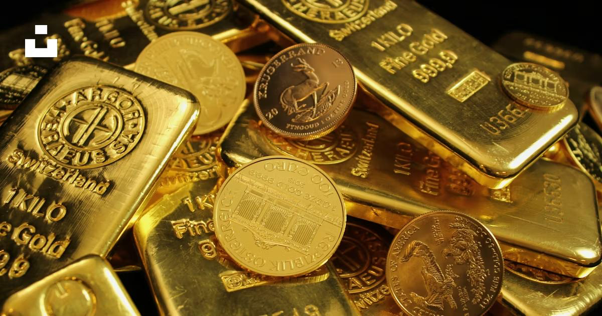
Figure 1: Gold bullion bars and coins. Investor demand for the metal does not always translate into demand for mining shares. Credit: Zlaťáky.cz / Unsplash.
The Gold market outlook has become harder to read from a single indicator. Mining.com.au reported on 12 October 2026 that sentiment towards gold was approaching the weak levels seen in June. Its report included a chart credited to MacroCharts.
That observation describes confidence around gold. It does not establish that the metal has returned to its June price, or that a recovery is due.
For mining shareholders, the question is what follows. A lower valuation may have little immediate effect on a producer paying its bills from operating cash. An explorer preparing a share issue has more at stake.
Weaker Confidence Can Reduce What Investors Pay for Mining Shares
Investors buy a mining company partly for the cash they expect it to generate. Those expectations can change before the company reports another ounce of production.
Suppose a mine is operating to plan. Its equipment works, output meets guidance and costs remain within budget. If shareholders lower their assumptions about future gold prices, they may still decide the shares are worth less.
The reverse can happen when confidence improves. Buyers may pay more for expected earnings well before those earnings arrive.
This helps explain why a falling share price does not, by itself, prove that a mine has run into trouble. Readers need to check the latest operating announcement alongside the market move.
Mining Herald’s report on the commodities crunch affecting ASX mining stocks examines the wider pressures surrounding resource-sector valuations.
Selling Pressure Can Reach Miners Through a Lower Gold Price
Sentiment matters most to operating cash when it contributes to a change in the price received for gold.
September offered an example of competing pressures. The World Gold Council said stronger US Treasury yields, a firmer US dollar and reduced futures positions helped push gold lower during the month. Gold finished September at US$4,176 an ounce, down 8.5%. These are month-end figures, rather than a live quote.
| Measure | Starting position | Lower selling price |
| Gold received per ounce | US$3,000 | US$2,700 |
| All-in sustaining cost per ounce | US$2,000 | US$2,000 |
| Difference per ounce | US$1,000 | US$700 |
The selling price falls 10%. The difference between that price and the assumed cost falls 30%.
For an actual company, hedging arrangements, currencies and changing costs would also affect the result.
A Lower Share Price Can Make the Next Fundraising More Dilutive
An explorer may have promising drilling results and no mine revenue. Its next programme still needs paying for.
If investors become less willing to fund gold exploration, the company may have to accept a lower issue price, raise less money or revisit its work programme.
The arithmetic is straightforward. Raising A$20 million at A$1 a share requires 20 million new shares. At A$0.80 a share, raising the same amount requires 25 million new shares, before fees.
Existing shareholders who do not participate would own a smaller percentage of the company after either issue. The lower-priced issue creates more shares to raise the same cash.
A company with sufficient funding can afford to wait longer. One with drilling commitments and a falling cash balance has fewer choices. That is why the next quarterly cash-flow report can matter more than a favourable Gold price forecast.
Cautious Funding Can Push Back Drilling and Construction
Funding terms can eventually change what happens at a project.
An explorer could reduce the number of holes in its next programme. A producer might defer discretionary expansion while keeping essential operating work funded.
These are possible responses, not evidence that gold companies generally are cutting spending now.
The useful comparison is between the work announced and the cash available to complete it. A project timetable deserves closer attention when a large part of its funding remains unsecured.
Demand for Bullion Can Leave Mining Shares Behind
Weak sentiment does not mean every group of gold investors is selling.
Those purchases provided exposure to bullion. They did not finance a miner’s drilling or plant construction.
This distinction matters for the Gold mining stocks outlook. Strong demand for the metal can support producers’ selling prices, but it cannot guarantee demand for every producer’s shares.
What Happens Next?
When confidence weakens, a company has an opportunity to show what its business can deliver.
A production target is useful. Meeting it at the expected cost is more useful. Cash remaining after operating expenses and necessary spending gives shareholders another way to assess the result.
Readers following individual producers can compare these measures with Mining Herald’s coverage of West African Resources’ gold production.
| Company position | What to check next |
| Operating producer | Gold sold, realised prices, costs and cash flow |
| Producer funding expansion | Expansion spending and remaining cash commitments |
| Developer | Construction estimate and funding still required |
| Explorer | Cash balance, quarterly spending and planned drilling |
Mining Herald’s assessment is that sentiment becomes most useful when read alongside those figures. A weak market may create opportunities, but a lower share price alone does not establish value.
The next reports should show whether companies are delivering their plans and retaining enough cash to continue.
ALSO READ: Underground Gold Mining Economics: What Determines a Mine’s Break-Even Point?
FAQs
Q1. Weak sentiment on gold, does that mean the price has bottomed?
Ans. No. Sentiment can stay weak and a low reading does not time prices to recover.
Q2. How can mining shares drop, when production is steady?
Ans. Investors may expect lower future selling prices, higher costs or more expensive funding.
Q3. Do gold ETF inflows directly benefit mining companies?
Ans. Physically backed ETFs buy exposure to bullion. Their inflows do not directly provide capital to mining companies.
Q4. Which figures should mining shareholders watch?
Ans. Production, realised gold prices, costs, cash balances, debt obligations and the money required for planned work.
Disclaimer
This article provides general information and is not financial advice. Market figures relate to the dates stated. Examples are for illustrative purposes only and are not a forecast. Always do your own research. There may be more recent information available. All investments carry risk.
Filed under

About the author
Jonathon Brown
Jonathon Brown began his career as a broadcaster, working across markets in British Columbia before moving into financial journalism. Since 2017, he has specialised in stock market reporting, covering emerging companies across the healthcare, technology, mining and consumer sectors. He brings more than 15 years' experience to his reporting. A graduate of Vancouver Island University and the British Columbia Institute of Technology, Jonathon is focused on delivering clear, balanced reporting for investors.