

Key Takeaways
- 01 Capital discipline is reshaping commodity supply curves into 2026.
- 02 AI infrastructure capex is becoming a primary macro variable.
- 03 Central bank policy across AU, CA and US is converging on neutral.
Chalice Mining Limited (ASX: CHN) has widened its copper story. First-pass drilling at the Deep Blue Target has returned broad, low-grade copper-silver-gold hits. The system spans 1.2km of strike and remains open.
That is the short version. The longer version involves a 30km belt of Wheatbelt ground. It also includes a rare earth mystery still unsolved, and a nearby project that gives Chalice a useful yardstick.
Chalice Confirms a Broad Copper-Silver-Gold System at Deep Blue
The Company has reported initial assay results from its Deep Blue drilling programme. The Target sits within the Goomalling Copper Project in Western Australia’s central Wheatbelt.
It is located roughly 60km north-east of Chalice’s Gonneville Project. Reverse Circulation (RC) drilling was used to test the target for the first time.
The programme consisted of 16 holes for a total of 1,874m. Drilling was spread across three lines, spaced approximately 600m apart. Chalice describes this as a first-pass test of a target it defined in early 2026.
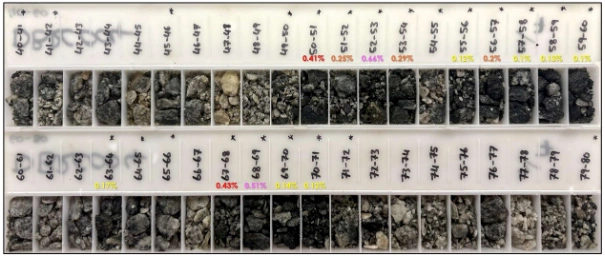 Figure 1: Chip tray photograph from hole DBRC004 spanning the reported 21m copper-silver-gold intersection. [Courtesy: Chalice Mining Limited]
Assay Results Point to a Consistent, Open Mineralised System
All 16 first-pass holes are now assayed, and the numbers back each other up. Deep Blue and the nearby Kann Target both tell a similar copper story.
Deep Blue Intercepts
Assays have now been received for all 16 holes. Copper-silver-gold mineralisation is present across multiple drill lines, at a consistent style and grade. This points to genuine strike extent, rather than an isolated pocket.
The standout intersections include:
| Hole ID | Interval | From (m) | Cu (%) | Ag (g/t) | Au (g/t) |
|---|---|---|---|---|---|
| DBRC004 | 21m | 50 | 0.18 | 0.67 | 0.03 |
| DBRC004 (incl.) | 4m | 50 | 0.41 | 1.20 | 0.07 |
| DBRC004 (incl.) | 2m | 67 | 0.47 | 2.38 | 0.04 |
| DBRC005 | 9m | 180 | 0.21 | 0.86 | 0.05 |
| DBRC014 | 1m | 55 | 0.47 | 4.25 | 0.05 |
Results are reported above a 0.1% copper cut-off. A 4m maximum internal waste allowance was applied. The Company says this reflects the low-grade, bulk-tonnage style of mineralisation seen so far.
Abundant visual chalcopyrite was logged across broad intervals in most holes. This corresponds to anomalous copper values above 400ppm, over widths of up to approximately 30m. Chalice notes this visual mineralisation extends well beyond the widths captured under its formal cut-off.
Kann Target Confirms a Parallel Trend
Previous aircore (AC) drilling also tested the Kann Target. Kann sits approximately 5km east of Deep Blue and returned comparable copper mineralisation.
The Company interprets this as a potential eastern flank, possibly linked by folding of the same sequence.
Hole ID
Interval
From (m)
Cu (%)
KAC010
4m
5
0.48
KAC017
13m (to EOH)
9
0.12
A Belt-Scale Opportunity With an Unsolved Rare Earth Twist
Deep Blue is one result within a much larger, largely unexplored corridor. A nearby comparison project and an unresolved rare earth anomaly both add weight to the story.
Drilling every one of 16 holes into mineralisation is a strong result for a first-pass programme. Chalice’s tenure covers approximately 30km of strike across the Goomalling belt. The Company says most of that ground remains untested by soil sampling or drilling.
The Company draws a comparison to the nearby Caravel Copper Project (ASX: CVV). Caravel sits approximately 15km north-west and hosts a ~3 Mt contained copper Mineral Resource, currently subject to a Feasibility Study.
Chalice is careful with this comparison. It relates to grade tenor and metal association only, not a confirmed shared deposit genesis.
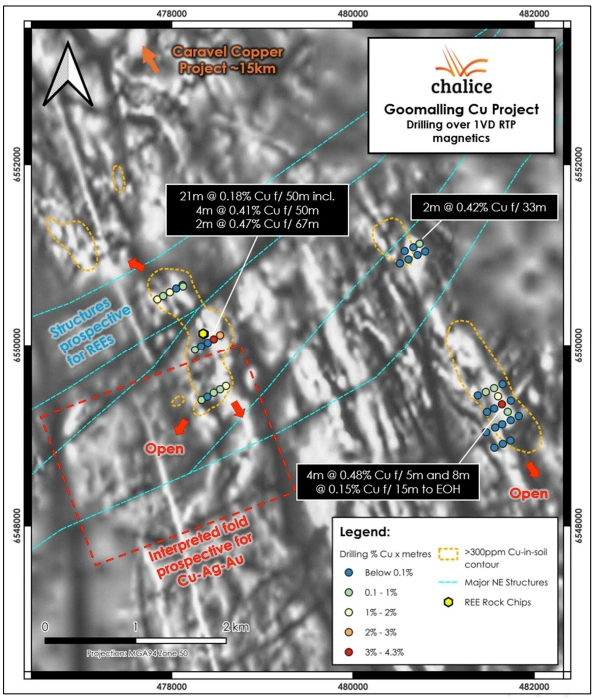 Figure 2: Drilling completed to date at the Goomalling Copper Project, shown over 1VD magnetic imagery. [Courtesy: Chalice Mining Limited]
The Rare Earth Question Remains Open
Previous rock chip sampling returned rare earth results above 15% TREO. This first-pass drilling has not identified their source.
The Company has since re-analysed existing soil data with a broader analytical suite. It identified anomalous TREO values coincident with large-scale, ENE-trending structures that crosscut the Deep Blue prospect. Those structures have not yet been effectively tested.
From PGM Hunt to Copper Belt: How the Goomalling Project Evolved
The Goomalling Copper Project did not start out as a copper story. Its exploration focus has shifted more than once since 2023.
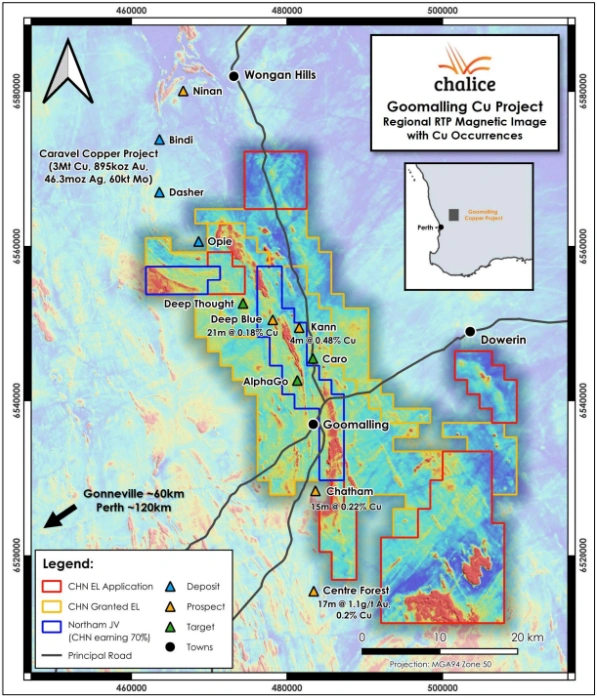 Figure 3: Chalice Mining’s Goomalling Copper Project tenure, prospects and nearby Caravel Copper Project deposits shown over regional magnetics. [Courtesy: Chalice Mining Limited]
Ownership and Tenure
Chalice holds the Goomalling Copper Project through a joint venture with Northam Resources Limited. Chalice may earn as much as a 70% stake under the deal. It also owns a set of exploration permits outright. Together they cover about 1,200 km² across the central Wheatbelt.
A Change in Exploration Focus
The exploration plan has changed once already. In 2023, Chalice looked for orthomagmatic sulphide targets. The aim was to find something like the Gonneville PGM-Ni-Cu-Co hit. In 2024, the team moved away from that idea and went after orogenic and hydrothermal copper-gold targets instead.
From late 2025 into 2026, soil work and shallow drilling were used to test the Deep Blue and Wongamine targets.
Geology of the Corrigin Tectonic Zone
This project lies in the Corrigin Tectonic Zone. It is a deformed area made of high-grade metamorphic rocks. It sits on the eastern margin of the Yilgarn Craton.
The host rocks at Deep Blue are migmatitic gneiss and granitoid. They have undergone significant metamorphism and structural reworking. Chalice states the nature of the mineral system is not yet fully understood.
Copper Demand Is Set to Outpace Supply Through 2040
Copper demand is forecast to grow more than most other minerals, in absolute terms. Global electricity network build-out and next-generation technologies underpin an estimated 7 million tonne increase in demand by 2040.
Supply gaps are expected to narrow as more projects reach production. A shortfall still persists under current base-case project pipelines. Refining and downstream capacity continues to lag upstream mine development across critical minerals more broadly.
This keeps new discoveries in stable jurisdictions, like Western Australia, strategically relevant.
Share Price Snapshot
| Metric | Value |
| Last Price | A$1.340 |
| Market Capitalisation | A$499.40 million |
| 52-Week Range | A$1.05 – A$2.75 |
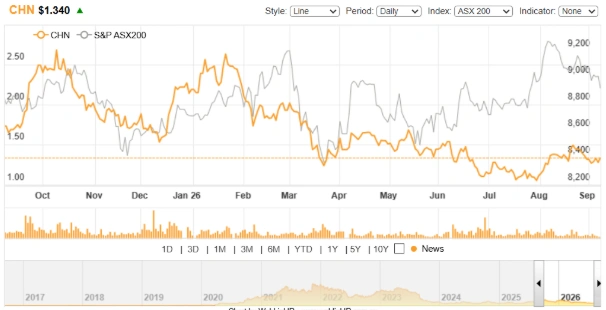 Figure 4: Chalice Mining share price performance against the S&P/ASX 200 over the past 12 months. [Courtesy: Chalice Mining]
Weighing the Opportunity Against Early-Stage Risks
As with any early-stage exploration result, investors should weigh this update against several risks:
- Geological continuity: current drill spacing is not sufficient to establish the grade and geological continuity required for a Mineral Resource estimate.
- Commodity price volatility: copper and silver prices directly affect the economics of any future development.
- Funding requirements: further drilling, geophysics and resource definition work all require ongoing capital.
- Regulatory and land access: exploration on freehold farmland depends on landholder access and seasonal cropping constraints.
- Unproven deposit style: the Company itself describes the target deposit style as currently enigmatic.
Structural Targeting and an IP Survey Chart the Next Steps
Chalice has interpreted fold hinges within the deformed host sequence as a possible vectoring tool. This draws on an observation at Caravel, where higher-grade mineralisation correlates with tightly folded structural positions.
Two priority fold targets have been identified. One sits immediately south-west of Deep Blue. The other is approximately 4km north-west, at the Deep Thought prospect.
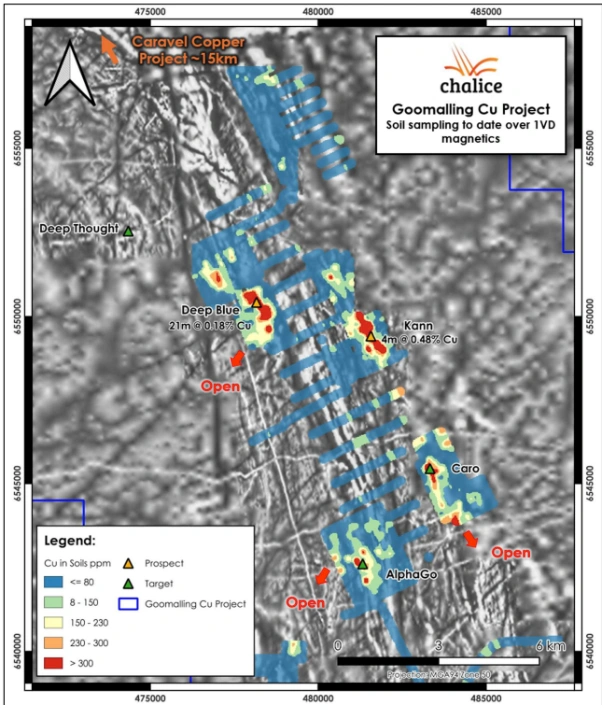 Figure 5: Soil sampling completed to date across the Goomalling corridor, shown over 1VD magnetic imagery. [Courtesy: Chalice Mining Limited]
Planned Follow-Up Work
Planned work includes an Induced Polarisation (IP) survey. This is intended to exploit the conductivity contrast between chalcopyrite mineralisation and the surrounding resistive host rock. Extended and infill soil sampling, covering the full rare earth element suite, is also planned.
This work is scheduled to begin in the December 2026 quarter, once the cropping season ends on the largely freehold farmland.
Impact on Chalice’s exploration pipeline: a positive IP and structural targeting outcome would move Deep Blue from reconnaissance toward a more defined drilling target, within a belt the Company says remains substantially unexplored.
Mining Herald will continue tracking the mid-cap company’s assay results and IP survey outcomes at Deep Blue. This is a large, mostly untested corridor worth watching closely.
ALSO READ: Global Expansion Meets Profit Surge: Experts Pick This ASX 200 Blue-Chip as a Top Buy
FAQs
Q1. What is the Deep Blue Target?
Ans. A copper-silver-gold-rare earth exploration target within Chalice Mining’s Goomalling Copper Project in Western Australia’s central Wheatbelt.
Q2. What did the latest drilling find?
Ans. Broad, low-grade copper-silver-gold intersections across 1.2km of strike, with the system remaining open along strike.
Q3. How does Deep Blue compare to Caravel Copper Project?
Ans. Chalice considers the mineralisation style broadly comparable in grade tenor and metal association, though not confirmed as the same deposit type.
Q4. What happens next at Deep Blue?
Ans. An Induced Polarisation survey and expanded soil sampling are planned for the December 2026 quarter, targeting structural positions prospective for higher-grade copper and rare earths.
Disclaimer
This article is intended for informational purposes only. If you pay attention to the ASX and the mining and resources sector as an investor, all data in this content is from third-party sources. Please check out the complete share price and market data information. Investing carries a high risk, and you should only invest at your own risk. Mining Herald has no involvement in the above-listed company.
Filed under

About the author
Jonathon Brown
Jonathon Brown began his career as a broadcaster, working across markets in British Columbia before moving into financial journalism. Since 2017, he has specialised in stock market reporting, covering emerging companies across the healthcare, technology, mining and consumer sectors. He brings more than 15 years' experience to his reporting. A graduate of Vancouver Island University and the British Columbia Institute of Technology, Jonathon is focused on delivering clear, balanced reporting for investors.