


Key Takeaways
- 01 Capital discipline is reshaping commodity supply curves into 2026.
- 02 AI infrastructure capex is becoming a primary macro variable.
- 03 Central bank policy across AU, CA and US is converging on neutral.
BHP Group Limited (ASX: BHP) held the BHP ESG Roundtable 2026 in Melbourne on 16 Sep 2026, starting at 9:00 am AEST. The timing was awkward. Executives had to walk through safety numbers, decarbonisation targets and community spending just weeks after a death at one of their own sites, and the BHP sustainability strategy they presented had to account for both the wins and that loss.
Safety Data Improves, But One Loss Still Shapes the Message
High potential injury frequency, BHP’s key safety metric, fell 27% in FY2026 and 69% over the past five years. Group Health, Safety and Security Officer Warren Wellbeloved credited three things for the trend. Stronger critical control verification. Wider use of the BHP Operating System, known internally as BOS. Continued field leadership from frontline teams.
Technology also featured heavily:
- Robotic cathode stripping at Olympic Dam cut injuries from 11 to zero between FY2019 and FY2025
- Automated mill relining at Escondida trimmed confined-space exposure time by eight hours per change-out
- Autonomous haulage and AI-enabled monitoring helped lift hazard identification by 22% in FY26 versus FY25
- Around 46% of BHP’s truck fleet is now automated
BHP Climate Commitments Rest on Four Tier 1 Assets
The Company positions Western Australia Iron Ore, its Chilean and South Australian copper operations, BMA steelmaking coal and the Jansen potash project as commodities exposed to long-term demand from electrification, urbanisation and population growth.
The clearest evidence behind BHP climate commitments is the emissions trend itself: operational greenhouse gas emissions are down 33% from FY2020 levels, with the baseline and performance data adjusted for methodology changes.
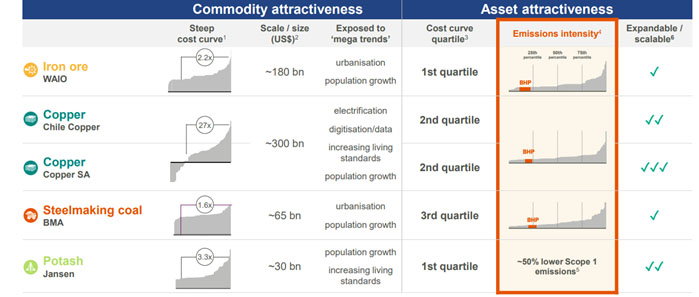
Figure 1: A comparison of BHP’s Tier 1 assets by cost position, scale and emissions intensity [Courtesy: BHP]
The Company has a goal of reaching net zero operational emissions by 2050 and continues to believe it is on track to achieve its medium-term target for Fiscal Year FY2030. Chilean Escondida and Spence are already 100% renewable power. In July 2026, BMA hit 100%. Copper SA sits at 35%, and Port Hedland is at up to 30%, both against FY2020 baselines.
Fleet Electrification Runs Into a Charging Problem
Andrew Larder, BHP’s Head of Decarbonisation Planning and Strategy, was candid about a real constraint. A pre-commercial 220-tonne battery-electric haul truck with a 3MWh battery loses around 1,000 hours of productivity per truck per year to static charging, compared with a diesel truck refuelled once daily in about 15 minutes.
BHP plans to trial Caterpillar’s Dynamic Energy Transfer charging technology at Jimblebar in FY27 to help close that gap.
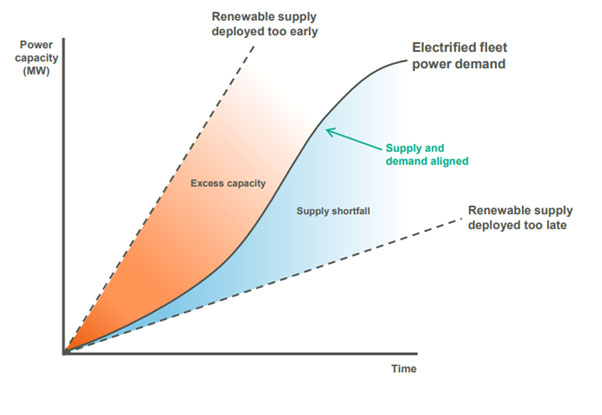
Figure 2: How BHP is sequencing renewable power supply against rising demand from its electrified fleet [Courtesy: BHP]
The Company also flagged a delay. Its Escondida Boiler Diesel Displacement project, originally due for completion in FY2026, has slipped to FY2027 because of construction delays. A related project at Spence is delayed as well. BHP said neither delay is expected to affect its FY2030 emissions target.
FY2027 Priorities Span Electrification, Infrastructure and Methane
BHP outlined a specific list of FY2027 commitments across four areas:
- Electrification: continue battery-electric haul truck trials at Jimblebar, begin Caterpillar Dynamic Energy Transfer trials, run in-service mainline locomotive testing, and complete the Escondida boiler diesel project
- Infrastructure: deploy battery-electric light vehicle charging and commission high-power static charging at Jimblebar
- Methane: finish a gas exploration drilling programme and continue drainage trials at Broadmeadow
- Renewables: reach 100% renewable electricity at BMA, based on forecast demand
Social Value Framework Links Community Spending to Business Performance
The clearest insight yet into that progress was provided at this year’s BHP ESG Roundtable 2026, where the Social Value Framework, which has been in place since June 2022, reached its halfway point against six areas of focus by FY2026.
| Focus Area | FY2026 Metric | Result |
| Decarbonisation | Operational GHG emissions vs FY20 | Down 33% |
| Healthy environment | Area under formal stewardship management | 246,000 hectares |
| Indigenous partnerships | Spend with Indigenous suppliers | US$1.0 billion (record) |
| Inclusive workforce | Female representation across the Group | 41.5% |
| Empowered communities | Total economic contribution | US$50.8 billion |
| Responsible supply chains | Towards Sustainable Mining Performance | Strong across BMA, WAIO, Olympic Dam, BHP Corporate |
Of the US$50.8 billion total economic contribution, US$44 billion went to suppliers, contractors, employees, governments and community investment, with the remaining US$6.8 billion paid to shareholders.
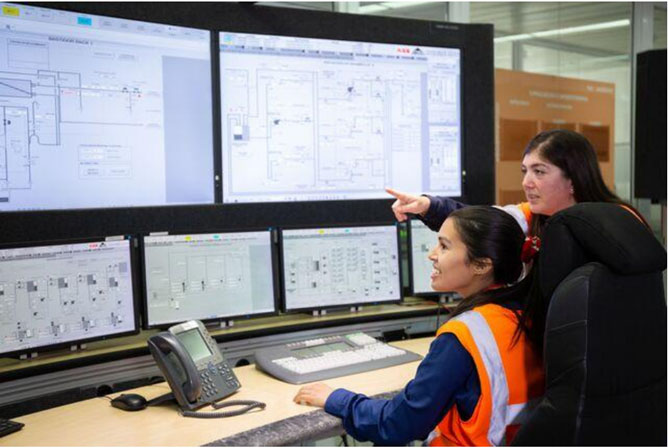
Figure 3: BHP employees monitoring autonomy-related systems from a control room at Escondida [Courtesy: BHP]
At Jansen in Canada, BHP has awarded more than C$1.7 billion to Indigenous partners since 2021, with Indigenous employment above 20%. Copper SA has also shifted freight from road to rail with Aurizon, a move expected to cut 13 million truck kilometres and up to 20 kilotonnes of Scope 3 emissions annually once fully operational.
Share Price and Performance Snapshot
| Metric | Value |
| Last price | A$60.040 |
| Market capitalisation | A$301.23 billion |
| 52-week range | A$39.300 to A$68.770 |
| 2026 year to date | +31.99% |
| 1 year change | +47.27% |
| vs Sector (1 year) | +13.30% |
| vs ASX 200 (1 year) | +49.23% |
BHP Times Its Next Moves to Trial Results
BHP is not committing to a fixed electrification timeline. Instead, it is sequencing decisions around trial results and power readiness.
- Impact on fleet electrification: the FY27 Caterpillar Dynamic Energy Transfer trial at Jimblebar will test whether dynamic charging closes the roughly 1,000 hours per truck lost to static charging each year
- Impact on the FY2030 emissions target: the delayed Escondida and Spence diesel displacement projects are now due in FY2027, though BHP says this will not affect the FY2030 goal
- Impact on the Pilbara power network: an MoU with Yindjibarndi Energy Corporation and the Pilbara Electricity Transition Plan remain exploratory, with no funded project yet
- Impact on BMA: the site is targeting 100% renewable electricity in FY2027, based on forecast demand
Mining Herald will continue to track BHP’s progress against these FY2027 and FY2030 targets.
ALSO READ: EV Revolution Accelerates Lithium Mining Race Across Australia & South America
FAQs
Q1. Why did safety dominate BHP’s 2026 ESG Roundtable?
Ans. A colleague died at Peak Downs in July 2026. BHP is still investigating, and that loss shaped how the whole session was framed.
Q2. What is actually holding back battery-electric trucks?
Ans. Charging time, mostly. A single truck can lose around 1,000 hours a year sitting at a static charger instead of hauling ore.
Q3. Did every FY2026 milestone get delivered?
Ans. Not quite. The Escondida and Spence diesel displacement projects both slipped into FY2027 because of construction delays.
Disclaimer
This article is intended for informational purposes only. All data referenced is drawn from BHP’s official exchange release and ESG Roundtable presentation dated 16 Sep 2026. Readers should verify current figures independently before making investment decisions. Mining Herald has no involvement with BHP Group Limited and does not provide investment advice.
Filed under

About the author
Jonathon Brown
Jonathon Brown began his career as a broadcaster, working across markets in British Columbia before moving into financial journalism. Since 2017, he has specialised in stock market reporting, covering emerging companies across the healthcare, technology, mining and consumer sectors. He brings more than 15 years' experience to his reporting. A graduate of Vancouver Island University and the British Columbia Institute of Technology, Jonathon is focused on delivering clear, balanced reporting for investors.