

Key Takeaways
- 01 A mining share gives you an interest in the company. The business may already operate a mine, or it may still be looking for a deposit.
- 02 Companies often return to shareholders for funding as their projects advance. New share issues can reduce an existing investor’s percentage ownership.
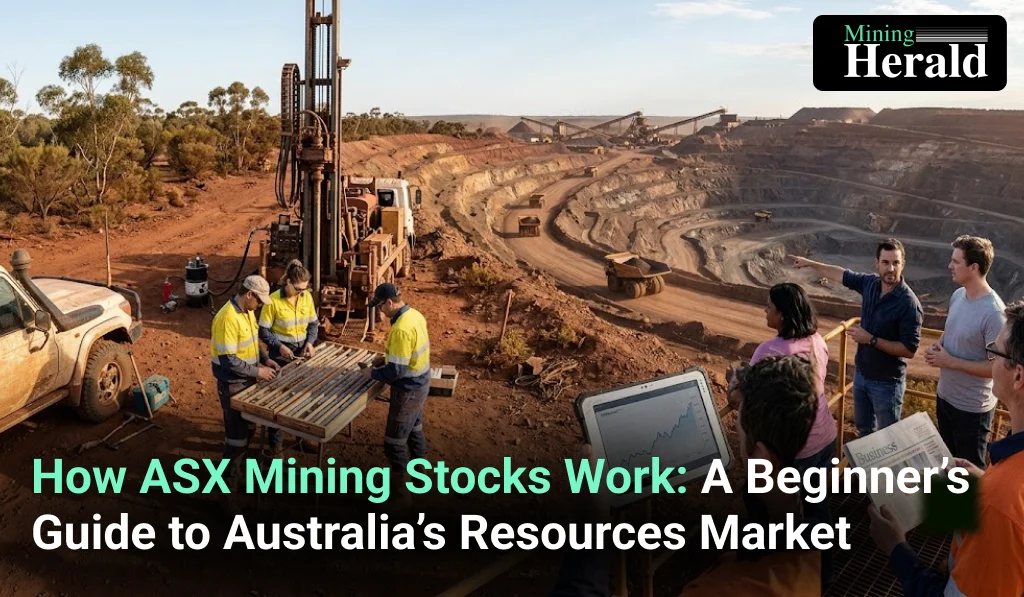
- 03 ASX lists more than 860 metals and mining companies operating across 85 countries.
A useful place to start when learning how ASX mining stocks work is the company’s latest report. Look for sales, production and cash. If there are no mineral sales, find out how the business pays its bills.
Perhaps it raised money recently. Perhaps it has a partner funding exploration. Or it may soon need another share issue to keep work moving.
None of those arrangements alone tells you whether the company is a good investment. They do tell you what kind of business you are examining. A company searching for copper needs to be assessed differently from one already shipping it.
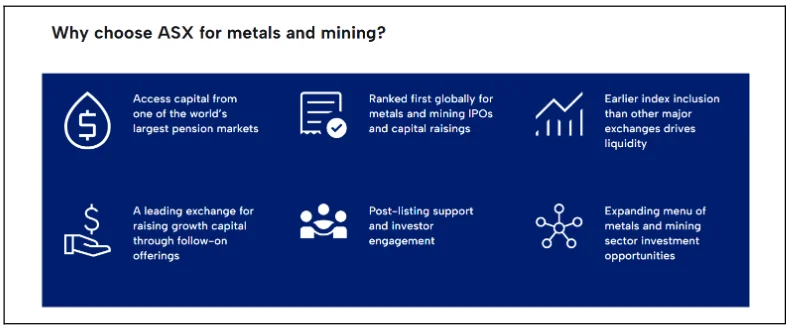
Figure 1: ASX is home to more than 860 metals and mining companies with operations spanning 85 countries. Credit: ASX.
Why Is Mining Such a Large Part of ASX?
ASX reports more than 860 metals and mining companies with operations in 85 countries. The range includes small explorers and businesses operating several mines.
Australia also has a substantial institutional investor base, including its superannuation sector. For companies seeking money, that is part of the attraction.
The exchange’s metals and mining overview ranks ASX first for mining IPOs and capital raisings by transaction count in a comparison covering 2016–2025. The comparison uses selected exchanges and includes junior boards where applicable. It measures fundraising activity, not shareholder returns.
An Australian listing can therefore help finance work well beyond Australia. Always check the location of the actual project.
Three Stages Worth Knowing
For this ASX mining investment guide, the first distinction is between finding a deposit, developing it and operating a mine.
| Stage | Where the company stands | What to look at |
|---|---|---|
| Explorer | Surveys, sampling and drilling are being used to assess ground | Results, ownership and money available for further work |
| Developer | The company is studying or building a project | Funding, approvals, construction costs and timing |
| Producer | Material is being mined, processed and sold | Output, expenses, selling prices and cash retained |
These are broad descriptions. A producer can also have exploration ground and an unfinished development.
Nor does every explorer become a producer. Work may stop, a project may be sold, or studies may show that development is uneconomic under the assumptions used.
What Happens to Existing Shareholders?
A new share issue increases the number of shares in the company. Unless an existing investor participates sufficiently, their percentage ownership falls.
Here is a hypothetical example:
- You own one million of a company’s 100 million shares: a 1% holding.
- The company issues another 25 million shares.
- You buy none of them.
- Your one million shares now represent 0.8% of the total.
You have the same number of shares. You own a smaller proportion of the business.
This is dilution. The company has also received cash, so the effect on value needs a closer look. What price did the new investors pay? What will management do with the money? Does it cover the next programme, or only part of it?
A Higher Metal Price Helps, but Costs Still Matter
Suppose a producer receives more for its gold this quarter. That sounds encouraging.
Then its report shows lower production, higher fuel expenses and unexpected repairs. The better selling price may cover some of those costs without leaving much additional cash.
The same issue appears in other commodities. A developer can benefit from stronger copper prices while facing a much larger construction bill.
Mining Herald’s report on the pressure facing ASX mining stocks looks at the way funding and operating costs affect the sector. Its coverage of gold prices and interest-rate pressure explains another influence on precious-metals shares.
The commodity price deserves attention. It just cannot tell the whole company story.
Ten Cents Can Still Be Expensive
A low share price is easy to mistake for a low company valuation. Readers looking into Australian mining stocks for beginners soon encounter unfamiliar terms.
Consider two hypothetical businesses:
| Company | Shares on issue | Price per share | Market capitalisation |
|---|---|---|---|
| A | 1 billion | AUD 0.10 | AUD 100 million |
| B | 10 million | AUD 5.00 | AUD 50 million |
Company A trades at ten cents but has twice the market capitalisation of Company B.
What Happens Next?
Investors generally use a broker with ASX access.
A market order trades at available prices. A limit order sets the most you will pay to buy, or the least you will accept to sell. It may not be filled.
Check fees as well as price and quantity. With a thinly traded stock, there may be few shares available at the price you last saw.
Moneysmart’s guide to buying and selling shares explains the order process. Delays, revised costs and changes in funding can all affect the original investment case.
FAQs
Q1. Are dividends paid by all mining stocks?
Ans. No. Many companies require their cash for exploration, construction, operations or debt.
Q2. Can an ASX mining company have offshore projects?
Ans. Yes. ASX-listed mining companies operate in multiple countries.
Q3. Why do the mining companies raise money more than once?
Ans. As the work proceeds, projects frequently require more funding. The raising announcement should specify where the money will go.
Q4. What to read before buying?
Ans. Recent announcements, activities, and cash-flow reports, and the most recent financial statements are good starting points.
Disclamer
This article is for broad educational purposes only and is not intended to provide individual financial advice. You can also lose all the money you invested in mining investments, which may have no value. Please review the current corporate disclosures and your situation before investing.
Filed under

About the author
Jonathon Brown
Jonathon Brown began his career as a broadcaster, working across markets in British Columbia before moving into financial journalism. Since 2017, he has specialised in stock market reporting, covering emerging companies across the healthcare, technology, mining and consumer sectors. He brings more than 15 years' experience to his reporting. A graduate of Vancouver Island University and the British Columbia Institute of Technology, Jonathon is focused on delivering clear, balanced reporting for investors.