


Key Takeaways
- 01 Capital discipline is reshaping commodity supply curves into 2026.
- 02 AI infrastructure capex is becoming a primary macro variable.
- 03 Central bank policy across AU, CA and US is converging on neutral.
The debate around Australian mining royalties comes down to a practical question: when can a new mine afford to pay? Construction consumes capital before sales begin, and the first shipments do not necessarily mean an operation has settled into reliable production.
Australia’s Critical Minerals Royalty Shift brings that timing into focus. NSW has introduced targeted payment deferrals, while a separate federal incentive will support eligible domestic mineral processing.
These measures address different costs. For mining companies and investors, their value will depend on eligibility, project timing and whether the underlying operation can earn enough to stand on its own.
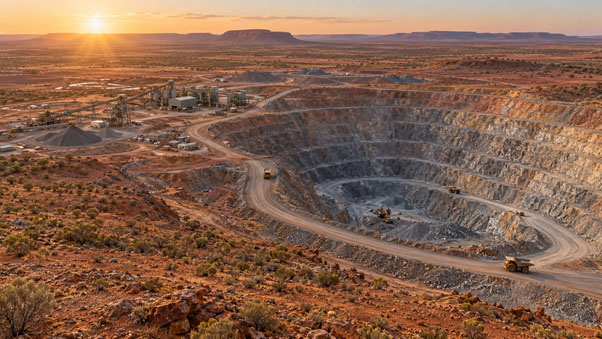
Figure 1: Conceptual view of an Australian mining operation, illustrating the infrastructure required before a project can generate steady revenue.
What Is Changing in Australian Mining Royalties?
The NSW Critical Minerals Royalty Deferral Scheme allows eligible projects to defer payments for up to five years. Repayment follows through quarterly instalments over the next five years, with interest accruing on deferred amounts.
The scheme has an A$250 million statewide cap. It changes payment timing rather than removing the liability.
| Scheme Feature | Published Requirement |
| Maximum deferral | Five years |
| Repayment period | Following five years, in quarterly instalments |
| Interest | Accrues quarterly |
| Total scheme cap | A$250 million |
| Production commencement window | 1 July 2025–30 June 2030 |
This is a targeted state measure. Describing it as a blanket reduction in Australian mining royalties would overstate its reach.
Who Could Benefit From the Scheme?
Eligibility narrows the field considerably:
- NSW lease holders: Applicants must hold a mining lease and demonstrate recovery of an eligible mineral.
- Qualifying businesses: The published criteria require the lease holder and related parties to meet a market capitalisation or valuation threshold below A$5 billion.
- New mineral production: Rules address previous extraction of the same minerals from the relevant land.
- Projects within the timeframe: Recovery must begin within the scheme’s specified commencement window.
Holding a critical minerals asset alone does not establish eligibility.
Why Does Payment Timing Matter?
Consider a hypothetical mine that has started selling concentrate but is still adjusting its processing circuit. Wages, maintenance, electricity and transport bills continue even when output falls short of the development plan.
Keeping cash available during that period could help the operator resolve production problems without immediately returning to shareholders for more funding.
That is the potential investment benefit of royalty deferral. It may reduce the amount of outside capital needed during early operations.
The later repayment burden still belongs in the financial model. A developer should assess whether the mine can cover deferred payments and interest alongside its other obligations once the relief period ends.
For critical minerals investment, the useful question is how much the revised payment schedule improves resilience under realistic operating conditions.
How Could Mining Incentives Influence Funding Decisions?
The following are potential financing effects, rather than guaranteed outcomes:
- Smaller early funding gaps: Retained cash could help meet operating expenses while production builds.
- Less immediate dilution: A company might avoid or reduce an additional share issue if its cash requirements fall.
- More room for commissioning: Available funds could support adjustments needed to achieve planned output and product quality.
- Closer scrutiny of repayments: Lenders will still examine whether later cash generation can cover accumulated obligations.
The benefit will vary between projects. A shortfall caused by payment timing is different from an operation whose production costs consistently exceed its sales income.
How Does the Federal Processing Incentive Differ?
The federal Critical Minerals Production Tax Incentive provides a separate form of support: a refundable tax offset equal to 10 per cent of eligible Australian processing expenditure.
It will operate from 1 July 2027 to 30 June 2040, with support available for up to 10 years per registered processing activity, subject to the programme’s end date and eligibility requirements.
Its focus is processing and refining. It does not amount to a 10 per cent reduction in every cost associated with developing a mine.
For example, A$100 million of qualifying processing expenditure would imply a A$10 million offset, assuming all relevant conditions were met. That calculation cannot simply be applied to a project’s total construction budget.
Together, these mining incentives could influence where companies commit capital. Each measure must first be assessed against the specific activities and expenditure involved.

Figure 2: Engineers reviewing a mineral processing facility
Why Does Project Quality Still Come First?
An incentive cannot establish the size of a deposit or prove that a processing method works.
Mining Herald’s coverage of Trek Metals’ follow-up drilling at Kuro illustrates the earlier work involved: testing targets, interpreting results and determining what further exploration is needed.
Kuro is a Western Australian exploration discovery, so the connection here is the development process, rather than eligibility for NSW’s scheme.
For ASX mining stocks, that distinction matters. An explorer discussing encouraging assays is at a different stage from a developer arranging construction finance or a producer improving recoveries.
Supportive mining policy may improve project economics. Geological evidence, saleable output and customer demand still determine whether there is a business worth financing.
What Should Investors Watch Next?
Company announcements become more useful when they explain the financial consequences:
- Confirmed eligibility: Has support been approved, or is management still assessing an application?
- Quantified cash-flow effects: How much funding could the measure release, and when?
- Complete repayment assumptions: Do forecasts include deferred royalties, interest and other liabilities?
- Production evidence: Are throughput, recovery and product quality approaching planned levels?
- Remaining finance: How much capital is still required after allowing for the incentive?
These details help readers distinguish a potentially useful benefit from a broad claim about favourable policy.
What Happens Next?
The next meaningful steps will be project-specific: financing agreements, construction decisions, commissioning results and evidence of reliable sales.
Australia’s Critical Minerals Royalty Shift could give qualifying developers more flexibility during a difficult stage. Whether that flexibility attracts lasting critical minerals investment will depend on what companies achieve with it.
For Australian mining royalties, moving a payment date can improve the early cash position. The stronger outcome is a mine capable of meeting its obligations when they eventually fall due.
Also Read: Why Critical Minerals Are Key to the Global Energy Transition
FAQ
Q1. Is Australia removing royalties on critical minerals?
The NSW measure provides temporary payment deferral for eligible projects, rather than a nationwide royalty exemption.
Q2. Are deferred NSW royalties interest-free?
No. Interest accrues quarterly.
Q3. When does the federal processing incentive begin?
It becomes available from 1 July 2027, subject to eligibility and registration.
Q4. Do these incentives guarantee a profitable mine?
No. Costs, recoveries, commodity prices, financing and operating performance remain decisive.
Disclaimer
This article has been prepared for Mining Herald for informational purposes only and does not constitute investment advice. Information is derived from NSW Resources and Australian Government publications and referenced reporting. Readers should verify programme conditions, company disclosures and market data independently before making any investment decision. Incentive eligibility and potential developments are subject to technical, regulatory, financial and commercial uncertainties.
Filed under
About the author
Mining Herald
Senior markets editor at Mining Herald. Covers resources, macro and corporate strategy across Australia and North America with two decades of capital markets experience.