

Key Takeaways
- 01 Capital discipline is reshaping commodity supply curves into 2026.
- 02 AI infrastructure capex is becoming a primary macro variable.
- 03 Central bank policy across AU, CA and US is converging on neutral.
The latest Australia mineral exploration figures show an industry maintaining investment while changing its priorities. Geoscience Australia’s review, released on 3 August 2026, recorded almost unchanged annual expenditure, but a substantial increase in gold exploration.
For mining companies, investors and policymakers, the question is where that work could lead. Spending supports the search; it cannot guarantee a commercially significant discovery.
The $3.9 Billion Exploration Question therefore has no single geographical answer. Established goldfields offer known mineral systems and infrastructure. Less explored regions offer opportunities that still require extensive testing.
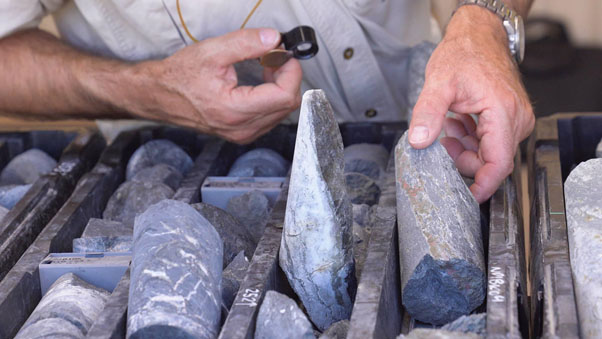
Figure 1: Detailed inspection of diamond drill core helps geoscientists interpret subsurface rock structures and mineralisation. Image credit: Michael O’Rourke, Geoscience Australia.
What Happened to Exploration Spending?
Australia’s overall mineral exploration spend rose 0.2 per cent in 2025. Gold spending was up 34 percent and was 40 percent of the national total, while silver-lead-zinc spending rose 20 percent.
Critical mineral expenditure declined, although critical minerals featured in 32 maiden Mineral Resource discoveries.
| Measure | Calendar 2025 result |
| Total mineral exploration expenditure | A$3.9 billion |
| Annual expenditure change | +0.2% |
| Gold’s share of expenditure | 40% |
| Growth in gold exploration expenditure | 34% |
| Maiden resource announcements | 69 across 50 projects |
Geoscience Australia’s Australian Mineral Exploration Review announcement.
The totals reveal where exploration effort is being directed. They do not measure the value of deposits discovered or the number of mines that will eventually operate.
Where Could the Next Major Discovery Emerge?
Geoscience Australia’s findings point to several areas worth watching:
- Established mining districts: Prospectors can test deeper targets, extensions of known mineralisation and areas missed by earlier drilling. The existing geological data can be used to focus future targets.
- Yilgarn region, Western Australia: The Yilgarn is a key region for potential new discoveries owing to a concentration of maiden resources.
- Frontier areas in northern Australia: These are still relatively underexplored and potentially highly prospective, but teams will need to first determine if the geology is conducive to a viable mineral system.
- Risks still exist: Mature districts can still underperform and remote finds are likely to be more costly to develop and service.
Ultimately, neither pathway guarantees success. Drilling results, resource size and project economics will determine which discoveries move forward.
Better Targets Matter More Than Bigger Budgets
The practical challenge for Australia mineral exploration is choosing where to drill and learning enough from each hole to improve the next decision.
A geophysical anomaly is a target for investigation. It becomes more useful when supported by geological mapping, sampling and drilling.
Mining Herald’s coverage of Trek Metals’ follow-up drilling at Kuro illustrates this process. The company is combining geophysical surveys with drilling to test for additional manganese mineralisation beneath sand cover.
Kuro also shows why promising assays and resource definition are separate milestones. Further drilling and technical evaluation are needed to establish the discovery’s scale and commercial potential.
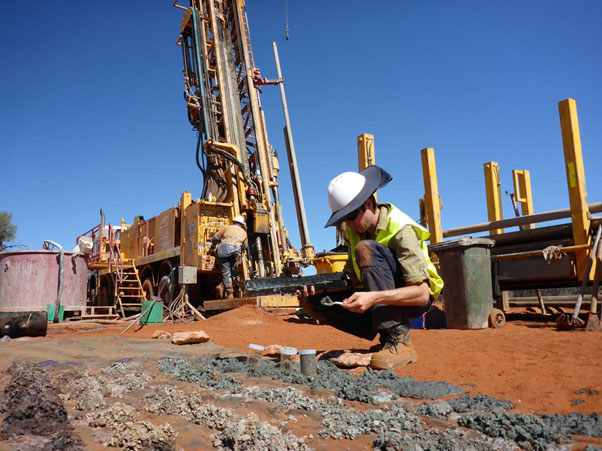
Figure 2: Geological sampling beside an exploration drilling rig provides evidence for evaluating subsurface targets. Image credit: Geoscience Australia.
Public Data Is Helping Narrow the Search
Geoscience Australia’s Resourcing Australia’s Prosperity initiative combines national mapping, resource assessments and detailed regional investigations.
Its initial 2024–34 roadmap includes assessments across 12 onshore regions. The work also covers groundwater and other resources relevant to development.
For explorers, the potential benefit is access to information that would be difficult for an individual company to collect across a large area. Regional datasets can help identify promising settings before committing to more expensive fieldwork.
The initiative’s GeoInsight platform brings together geological and resource information to support regional assessment.
For policymakers, the same evidence can inform infrastructure planning. A prospective area needs more than favourable geology: water availability, access and competing land uses also deserve attention.
Why a Resource Announcement Is Only One Step
New mineral discoveries attract attention because they may become future sources of supply. However, a promising intersection, a Mineral Resource and an operating mine represent different stages.
A resource estimate describes mineralisation supported by geological evidence. Further studies must establish whether mining and processing can be economically justified.
That is why a larger resource does not automatically mean a better investment. Depth, recovery, waste movement, infrastructure and capital requirements can change the development case.
For readers following mining exploration Australia, the broader question is whether discoveries can progress into workable projects. Counting announcements alone misses that commercial test.
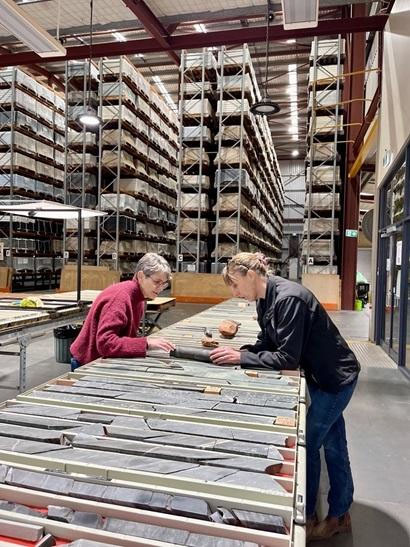
Figure 3: Researchers examine stored drill core, which can support fresh interpretation of previously explored mineral systems. Image credit: CSIRO.
What Should Industry Readers Watch Next?
For investors assessing ASX mining stocks, the most useful updates explain what has changed in the geological or development case.
- Follow-up drilling: Does it confirm the initial interpretation?
- Continuity: Is mineralisation demonstrated across multiple holes?
- Resource confidence: Is additional work improving geological certainty?
- Processing: Can valuable minerals be recovered effectively?
- Funding: Does the company have enough cash for its next programme?
- Development constraints: What infrastructure, access and approvals remain necessary?
Mining executives can use these measures to compare projects competing for capital. Policymakers can use them to distinguish early potential from developments approaching a genuine infrastructure requirement.
What Happens Next?
Confirmed national work includes further mapping and regional assessments under the government’s published roadmap. At company level, progress will depend on individual drilling programmes, laboratory results and study outcomes.
The next major discovery cannot be named from expenditure statistics. What the data does establish is that exploration remains active across different commodities and geological settings.
For Australia mineral exploration, the decisive result will be evidence that survives repeated testing; and eventually supports a viable development.
Also Read: Why Critical Minerals Are Key to the Global Energy Transition
FAQ
Q1. Which year does A$3.9 billion cover?
Calendar 2025.
Q2. Which commodity attracted the largest reported share?
Gold, accounting for 40% of expenditure.
Q3. Does greater spending guarantee discoveries?
No. Outcomes depend on geology, targeting and exploration results.
Q4. Is a Mineral Resource an operating mine?
No. Technical, economic and development work remains necessary.
Disclaimer
This article has been prepared for Mining Herald for informational purposes only and does not constitute investment advice. Information is derived from Geoscience Australia publications and referenced reporting. Readers should verify company disclosures and market data independently before making any investment decision. Exploration results, resource estimates and potential developments are subject to geological, technical, regulatory and commercial uncertainties.
Filed under

About the author
Jonathon Brown
Jonathon Brown began his career as a broadcaster, working across markets in British Columbia before moving into financial journalism. Since 2017, he has specialised in stock market reporting, covering emerging companies across the healthcare, technology, mining and consumer sectors. He brings more than 15 years' experience to his reporting. A graduate of Vancouver Island University and the British Columbia Institute of Technology, Jonathon is focused on delivering clear, balanced reporting for investors.