

Key Takeaways
- 01 Cameco will buy all output from GLE's planned Paducah plant, priced off its own average realised contract price.
- 02 Silex's royalty could reach about US$100 million a year, but only at roughly 8 million SWU. The first stage is closer to 2 million SWU.
- 03 Early 2027 is the date to watch. That is when the US licence decision is expected.
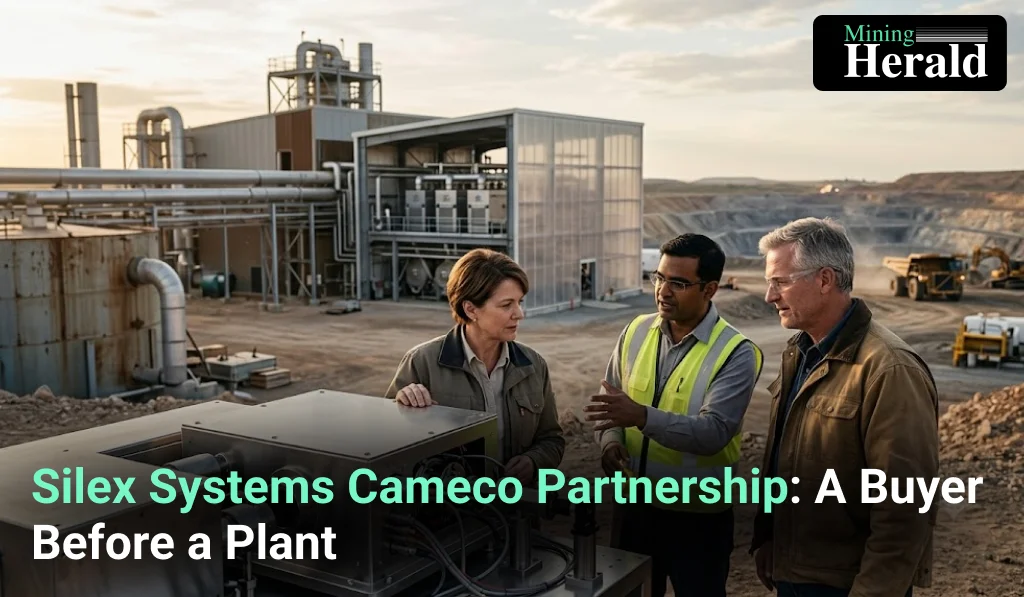
Silex Systems held its 2026 AGM on 16 October. The Silex Systems Cameco partnership took centre stage in the slide deck, and for good reason.
Offtake deals usually chase a finished design. This one landed while the full-scale equipment is still being designed.
What the Silex Systems Cameco partnership signed
Global Laser Enrichment (GLE) is the US venture that holds the licence to the SILEX laser process. Silex owns 51 per cent. Cameco owns the other 49 per cent.
On 14 September, Silex told the ASX that GLE and Cameco had signed an exclusive offtake agreement. Cameco takes everything the planned Paducah plant produces.
That covers natural uranium, low enriched uranium and, if advanced reactors create the demand, high-assay fuel known as HALEU.
The price is not fixed. GLE gets Cameco’s average realised price, net of selling costs, worked out each year across its long-term contract book. The AGM slides add a footnote: legacy contracts are left out.
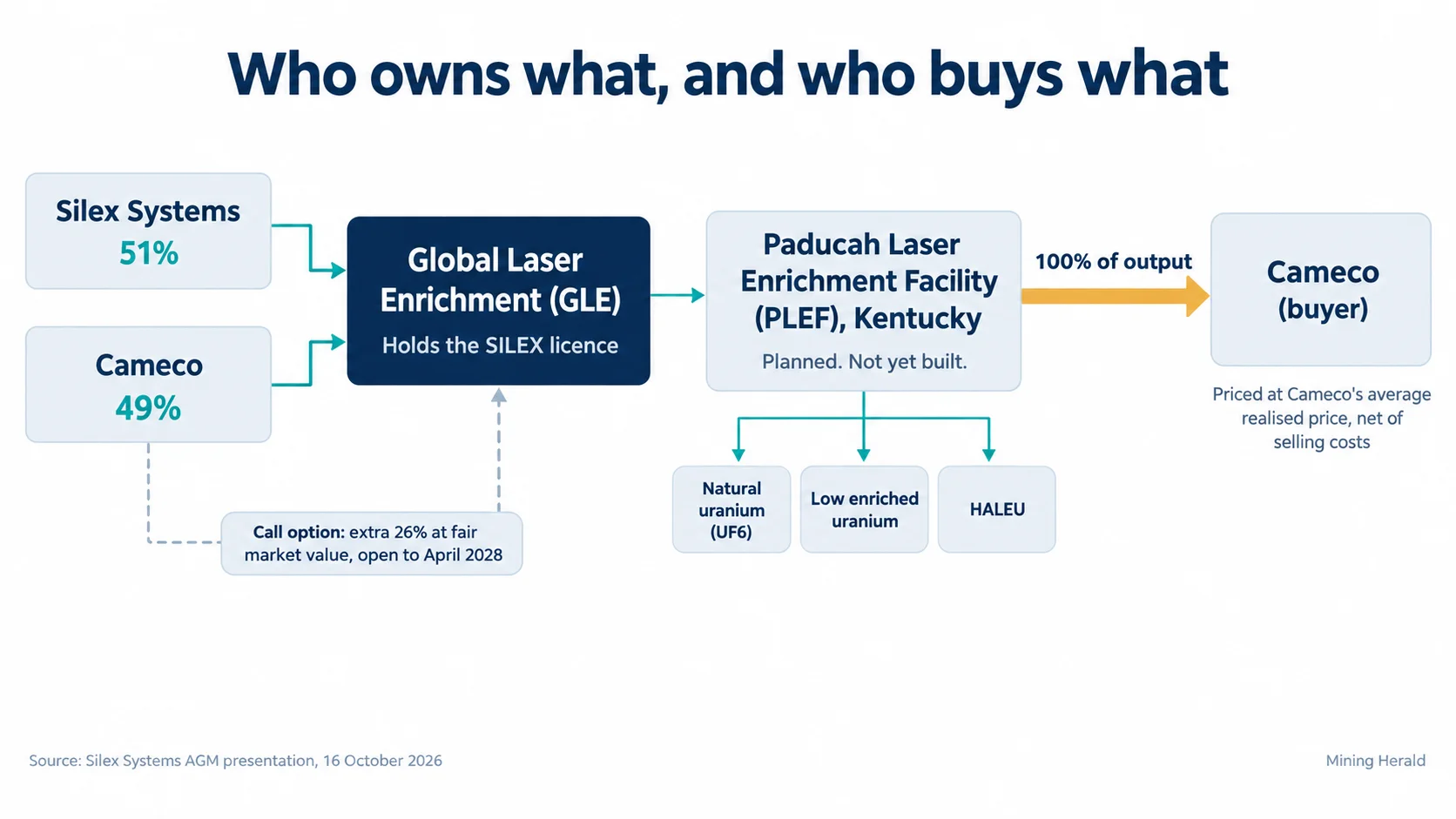
GLE sells all planned Paducah output to Cameco, which also owns 49 per cent of GLE. [SLX]
So GLE gets a blended market price and skips the cost of building a sales team. Silex chief executive Michael Goldsworthy called the deal a “home” for every product the plant makes, according to World Nuclear News.
Odd but true: the plant’s first big product is not enriched fuel. It is natural-grade uranium, recovered from leftover tails.
Those tails sit in about 25,000 cylinders at the old Paducah diffusion plant, roughly 200,000 tonnes of them. The company calls it the world’s largest above-ground uranium mine.
Silex’s own estimate puts all-in cost below US$30 a pound, against a long-term price near US$95. Those are company numbers, and nobody outside has tested them yet.
The royalty sums behind Silex Systems uranium enrichment
Silex gets paid two ways. It holds equity in GLE, and it collects a perpetual royalty of 7 to 12 per cent on enrichment revenue under the licence.
The deck’s headline example is about US$100 million a year. That assumes roughly 8 million separative work units (SWU), the standard measure of enrichment, at 7 per cent and about US$180 per SWU.
The first stage is smaller. The slides list initial output of 2 million SWU a year, expandable to 6 million.
Run the same 7 per cent on 2 million SWU and the royalty lands near US$25 million. That is a back-of-envelope sum from this desk, not a company figure.
The gap between those two numbers is the real story. The big royalty needs the big plant, and the big plant needs Cameco to find buyers for all of it.
Prices help the pitch. Term SWU prices are up about 200 per cent since February 2022, and only two Western suppliers, Urenco and Orano, operate outside Russia.
Cameco sits on both sides of the table
Cameco owns 49 per cent of GLE. It is the sole buyer. It also holds a call option to buy another 26 per cent at fair market value, open until April 2028.
That is three seats at the same table.
Nothing suggests a problem. Still, a price formula built on Cameco’s own contract book will shape what “fair market value” looks like when that option window shuts.
The read from this desk: the deal makes GLE easier to finance and easier to value. It could also make an option exercise easier to justify.
April 2028 falls after the expected licence decision in early 2027. The final investment decision has no public date.
Investors following ASX uranium stocks usually watch spot prices and mine restarts. This one runs on permits and engineering milestones instead, which is a different kind of wait.
Uranium enrichment technology still has three gates to clear
Gate one is the technology. The pilot-scale test (TRL-6) passed in October 2025, and work on the full-scale version (TRL-7) is under way.
Gate two is the licence. The US Nuclear Regulatory Commission accepted GLE’s application in August 2025, and approval is expected in early 2027.
Gate three is the money. Silex held about A$180.7 million in cash and term deposits at 30 June 2026, with no corporate debt.
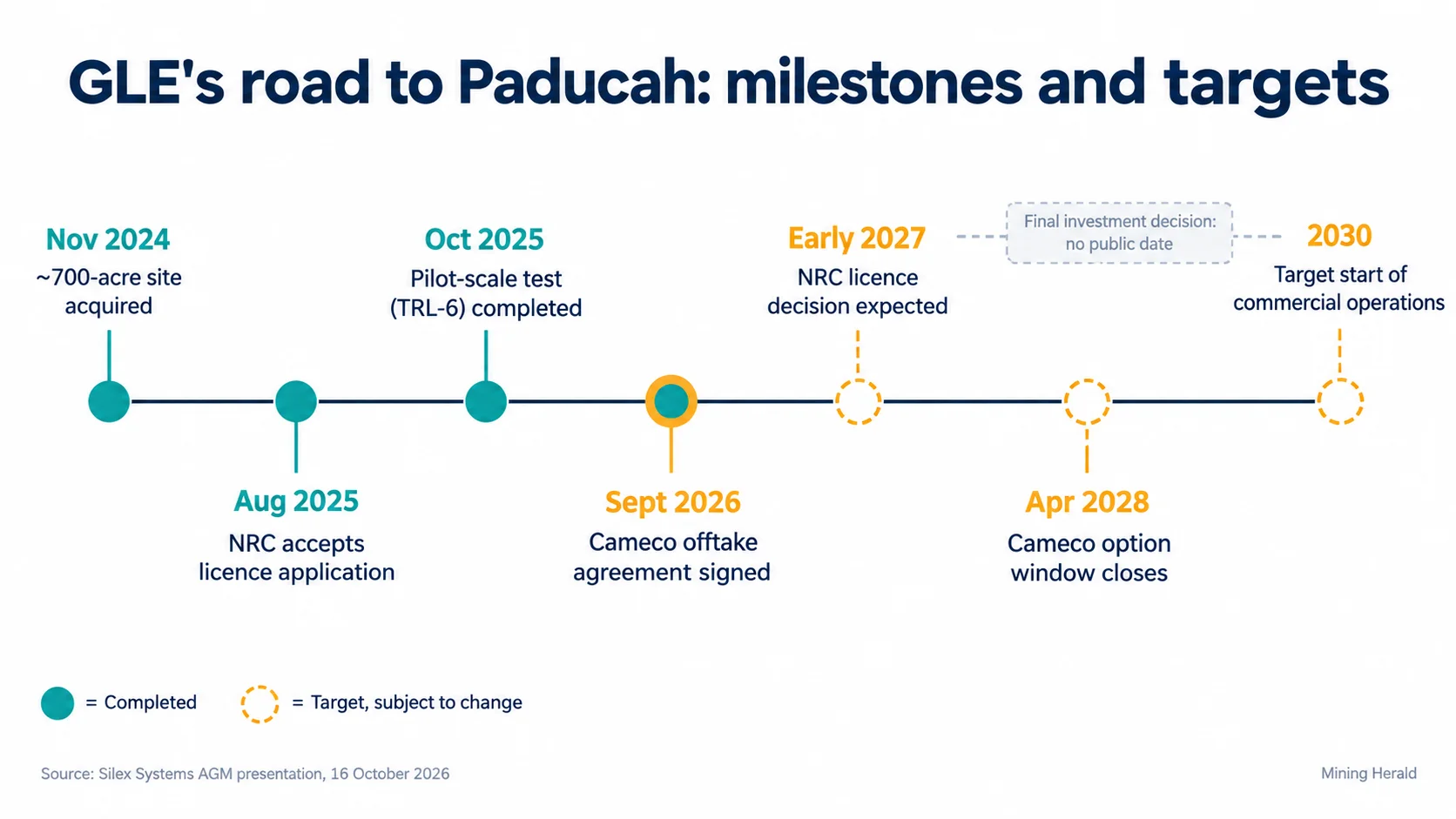
GLE’s indicative timeline for Paducah. All dates are targets and subject to change. [SLX]
Kentucky’s US$98.9 million incentive package was tied to a project investment of about US$1.76 billion. The slides do not show how that bill gets shared between Silex and Cameco.
Government cash has not filled the gap either. GLE received US$28.5 million from the US Department of Energy in January, but missed out on the department’s far bigger enrichment funding round that month.
Roughly US$600 million has gone into GLE over 20 years just to reach the pilot-scale mark. The nuclear fuel supply chain rewards patience, and this project has already spent two decades on it.
A signed buyer will not build a plant. It should give partners and lenders something solid to point at when the investment papers get written.
The date to circle is early 2027. A licence decision would turn this from a contract on paper into a plant with a permit.
FAQs
Q: What is the Silex Systems Cameco partnership?
A: Silex owns 51 per cent of GLE, Cameco owns 49 per cent, and Cameco now buys all GLE’s output.
Q: Does the offtake fix a price?
A: No. GLE receives Cameco’s average realised price, net of selling costs.
Q: Does Silex mine uranium?
A: No. It licenses laser technology, and GLE would recover uranium from DOE tails.
Q: When could the Paducah plant start?
A: GLE targets initial commercial operations by 2030, subject to licensing and a final investment decision.
Q: Is the plant approved?
A: Not yet. The NRC licence is expected in early 2027.
Disclaimer: General information only. This article is not financial product advice and does not consider anyone’s objectives or circumstances. Company estimates and targets are forward-looking and may not be met. Readers should seek advice from a licensed adviser before making investment decisions.
Filed under

About the author
Jonathon Brown
Jonathon Brown began his career as a broadcaster, working across markets in British Columbia before moving into financial journalism. Since 2017, he has specialised in stock market reporting, covering emerging companies across the healthcare, technology, mining and consumer sectors. He brings more than 15 years' experience to his reporting. A graduate of Vancouver Island University and the British Columbia Institute of Technology, Jonathon is focused on delivering clear, balanced reporting for investors.