

Key Takeaways
- 01 Capital discipline is reshaping commodity supply curves into 2026.
- 02 AI infrastructure capex is becoming a primary macro variable.
- 03 Central bank policy across AU, CA and US is converging on neutral.
For investors following PMET Resources stock, the latest resource upgrade raises questions beyond the size of the deposit. How much caesium can be recovered, what will processing cost, and who will take the finished product?
In this article, Mining Herald examines the new estimate, the work underway on processing and the commercial decisions that could shape the project’s development.
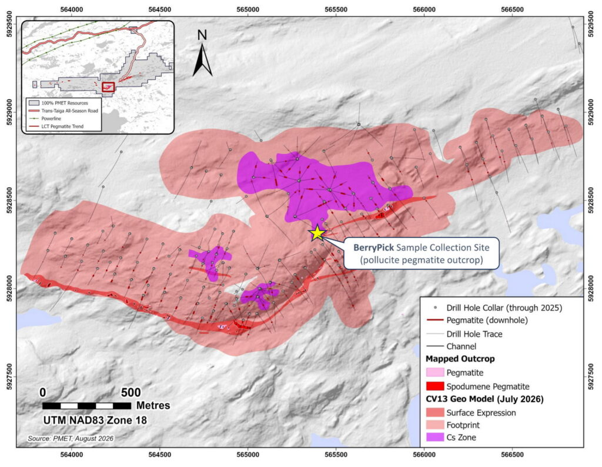
Figure 1: Pollucite-bearing pegmatite outcrop at the Vega Zone, CV13, used for PMET’s BerryPick sampling programme. Photograph published in September 2026. Credit: PMET Resources Inc.
The Resource Has Grown In Grade And Tonnage
PMET’s 4 November Australian announcement covers its wholly owned Shaakichiuwaanaan property in Quebec. The updated caesium estimate includes Vega, Rigel and a maiden estimate for Helios.
Contained caesium oxide rose 55%, supported by an 18% increase in tonnage and a 31% improvement in grade.
| Resource Category | Material | Cs₂O Grade | Contained Cs₂O |
| Indicated | 1,844,000 tonnes | 4.40% | 81,200 tonnes |
| Inferred | 981,000 tonnes | 3.00% | 29,400 tonnes |
The categories deserve separate attention. Inferred material carries less geological confidence than Indicated material. Neither figure represents finished product available for sale.
The oxide measure matters too. The headline refers to Cs₂O contained in the resource, rather than tonnes of pure caesium or recoverable chemicals.
Processing Will Decide How Much Value Can Be Captured
A buyer of a speciality chemical needs a product that meets its specifications. The grade of the rock is only the starting point.
PMET has been working with Koch Technology Solutions on extracting caesium from pollucite concentrate. Its September Phase 2 update reported encouraging selectivity and reduced impurities in bench-scale tests.
That could simplify the processing route. Removing fewer impurities may mean fewer treatment stages, although the company still needs to validate the process through to marketable samples.
For shareholders, the useful comparison will eventually be between the extra revenue and the full cost of earning it. Chemical processing requires equipment, reagents, energy and operating staff. A higher selling price alone cannot establish whether doing more processing improves the return.
This is where engineering becomes part of the investment case. Mining Herald’s coverage of Macmahon’s expansion into processing and engineering services examines the work involved in choosing and designing mine facilities.
Larger Samples Bring The Work Closer To Practical Decisions
The earlier chemical tests used roughly six kilograms of concentrate. PMET’s BerryPick programme is intended to provide considerably more material.
The September sampling announcement set an objective of producing 500–1,000 kilograms of pollucite concentrate for further development work. Ore-sorting tests were expected to begin in the fourth quarter, with results anticipated in the first half of 2027.
There is a practical reason to move beyond small samples. Engineers need enough material to test the process repeatedly and examine how it responds to differences in the feed.
A good result from selected material is useful. Consistent results across a wider sample give a project team more confidence when deciding what equipment to specify.
These trials remain development work. Producing test material does not establish commercial production capacity.
Buyers Must Grow Alongside Supply
The market question is particularly important when comparing caesium mining companies.
PMET identifies caesium formate used in demanding oil and gas wells as an established application. Other uses include speciality chemicals and catalysts. The company also sees potential in emerging technologies, including certain solar-cell applications.
Potential demand, however, needs to become orders.
A customer may require qualification samples before agreeing to purchase. It may need only a modest quantity initially, or want assurance that supply can continue for years. Those requirements affect how quickly a new producer should build capacity.
PMET itself recognises customer commitments, product qualification and inventory requirements as part of developing this market. That makes the timing of sales just as relevant as the amount of material underground.
For investors, a useful future announcement would explain the intended product, the buyer’s requirements and the proposed volume. Those details would make the revenue opportunity easier to assess.
Lithium Still Shapes The Development Plan
The Shaakichiuwaanaan lithium project remains anchored by lithium. Caesium offers a possible additional source of revenue alongside it.
PMET’s planned year-end studies separate two development questions: an updated lithium-tantalum feasibility study for CV5, and a broader preliminary economic assessment covering lithium, caesium and tantalum at CV5 and CV13.
A preliminary assessment can help compare development options. It should not be read as a final construction commitment.
The important issue will be whether adding another product improves the project after allowing for the extra work. Shared infrastructure could help. Additional processing equipment, operating complexity and working capital could offset part of that benefit.
Readers can follow the wider market through Mining Herald’s lithium industry coverage.
The Next Test Is What The Resource Can Earn
Mining Herald’s assessment is that the upgrade strengthens PMET’s development options, while leaving the commercial case to be demonstrated.
The next studies should allow investors to look beyond contained tonnes. Recovery assumptions, plant costs, production schedules and product pricing will show how much of the geological opportunity could translate into cash.
Customer agreements would provide another useful check. A large resource can support a long-lived business, but only if production matches what buyers need and what they are prepared to pay.
For now, the most useful question is how caesium changes the proposed operation’s economics.
ALSO READ: Lynas Rare Earths Quarterly Results: Is Growth Sustainable?
FAQs
Q1. Does the resource estimate show how much caesium PMET will sell?
No. Recoveries, processing losses, product specifications and the development plan will determine potential saleable output.
Q2. Why does resource classification matter?
It indicates geological confidence. Inferred resources require further work before they can support the same level of planning confidence as higher-confidence categories.
Q3. What is pollucite?
It is a caesium-bearing mineral. PMET is testing ways to process its pollucite concentrate into chemical products.
Q4. What should shareholders watch next?
Study economics, processing results, customer qualification and financing requirements. Together, these will help establish whether the additional product improves the project’s returns.
Disclaimer
This post offers basic financial information, not advice. Minerals do not guarantee economic viability. Further study is needed on development timeframes and commercial results. Investors should examine business statements and their particular circumstances before investing.
Filed under

About the author
Jonathon Brown
Jonathon Brown began his career as a broadcaster, working across markets in British Columbia before moving into financial journalism. Since 2017, he has specialised in stock market reporting, covering emerging companies across the healthcare, technology, mining and consumer sectors. He brings more than 15 years' experience to his reporting. A graduate of Vancouver Island University and the British Columbia Institute of Technology, Jonathon is focused on delivering clear, balanced reporting for investors.