

Key Takeaways
- 01 A study is only as reliable as its stage, reserves and assumptions.
- 02 Discounted cash flow with sensitivity testing is a better guide than EBITDA multiples.
- 03 Weak funding, closure costs or local opposition can sink a mine with a strong study.
Most investors read a feasibility study from the front page backwards. They see the valuation first, then look for reasons to believe it. The better habit is to start with the inputs.
Mining Project Feasibility Study Stages Signal Different Confidence Levels
Not every study carries the same weight. A scoping study is an early screen built on existing data and assumptions. Pre-feasibility studies include sampling and testing and engineering work. The final feasibility study is the most accurate of all estimates of the technical parameters of the mining operation, revenue and costs.
| Stage | Purpose | Investor takeaway |
| Scoping study | Early screen of scale, costs and potential | Rough guide only |
| Pre-feasibility study | Refines design with more data and testing | Shows whether further spending is justified |
| Feasibility study | Confirms technical and economic viability | Supports permits, funding and development |
The Company should state which stage it has reached. A scoping result presented as a final verdict deserves scepticism.
Reserves Carry More Weight Than Resources in Any Mine Plan
A mineral resource is a concentration of minerals with realistic prospects of eventual extraction. Confidence is graded as inferred, indicated or measured. A reserve is the part that can be mined economically. It has passed detailed review of mining, processing, marketing, legal, environmental and social factors.
Every reserve is a resource. Not every resource becomes a reserve. A plan leaning on inferred material rests on the least certain tonnes.
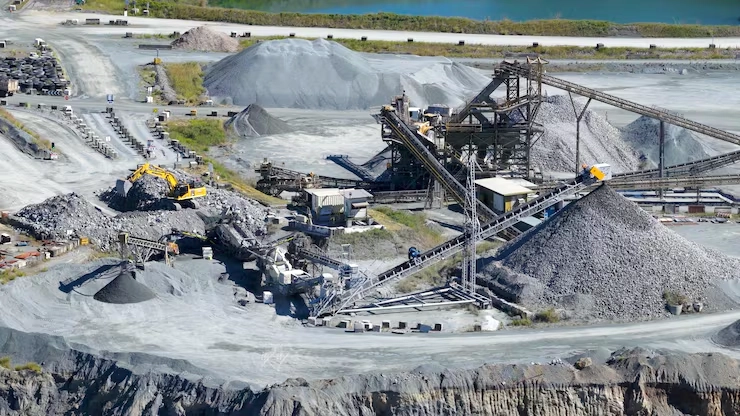
Figure 1: Aerial view of a processing plant and stockpiles at an open pit mine site. [Courtesy: Magnific]
Valuation Methods Reveal How Much Weight the Headline NPV Deserves
The preferred approach is a discounted cash flow model built on the study’s mine plan. Calculations for the Net Present Value (NPV) and Internal Rate of Return (IRR) can be performed. The model should cover every operating year until the deposit is depleted. Profits will vary as the ore grade and waste movement change, so a growth estimate cannot be assumed to be constant forever.
The discount rate needs to account for the metal or mineral, the project development phase and project-specific risks. EBITDA multiples are not ideal as the mining business can vary widely in project lifetime and annual profits.
| Method | Best suited to | Main limitation |
| P/NAV | Assets with a detailed life of mine plan | Relies on the study’s assumptions |
| P/CF | Producing mines | Excludes capital expenditure |
| EV/Resource | Early stage assets | Ignores build and operating costs |
| TAC | Early stage assets | Needs credible cost estimates |
P/NAV compares market capitalisation with NPV less net debt. TAC adds acquisition, build and operating costs per ounce.
Sensitivity analysis is a stress test. It shows the movement in NPV and IRR as key inputs are varied. A study that can withstand weaker inputs is more credible.
Five Checks That Help Evaluate a Mining Project Before Investing
- Commodity prices: The Company sells at whatever the market pays. Compare its price assumptions with independent forecasts. Do not lean on futures curves, because mining futures are too thin to hedge against.
- Jurisdiction: The ore stays where it is. Weigh the regulations, roads, power supply and local political mood before trusting the timeline.
- Unit costs: Understand what the project’s estimated production level will be to understand the competitiveness of the mine.
- Closure costs: Look for a line item covering rehabilitation of the site. Tax rules on these liabilities differ between regions, so check which assumption the study used.
- Social licence: Local support can make or break a schedule. Look for signs that the Company has earned trust with nearby communities.
Industry Outlook: RCF Sees Mining Valuations at Historic Lows
Resource Capital Funds (RCF) published an editorial on 18 Sep 2025. It said mining valuations were at historic lows against global equities. It also noted that deep valuation experience is rare. That is one investor’s view, not a forecast.
Reading the Study First Sharpens Investor Decisions
Understand the full context behind the findings and the potential impact on the Company and the investment if the mine is never built.
Technical reports should be read, and every headline number traced back to its assumptions. Mining Herald encourages readers to check those assumptions before committing capital.
ALSO READ: Macmahon’s Engineering Expansion: What Aspect Adds to Its Mining Business
FAQs
Q1. Define a mining feasibility study.
Ans. The evaluation is what determines whether a deposit can be developed into a working mine.
Q2. What are the differences between scoping, pre-feasibility and feasibility studies?
Ans. Each stage adds details. The best estimate of cost, revenue and technical parameters is the final feasibility study.
Q3. Why do we favour discounted cash flow over EBITDA multiples?
Ans. Mine lives and annual profits vary widely, so multiples are often unsuitable. A year-by-year model suits a deposit that depletes.
Q4. What can sink a mine even when the study looks strong?
Ans. Funding gaps, closure costs and weak community acceptance can all derail a project.
Disclaimer
This article is intended for informational purposes only. If you pay attention to the mining sector as an investor, then all the data in the content is from third-party sources. Please check out the complete share price and market data info. Investing carries a high risk, and you should only invest at your own risk. Mining Herald has no involvement in the above-listed companies.
Filed under

About the author
Jonathon Brown
Jonathon Brown began his career as a broadcaster, working across markets in British Columbia before moving into financial journalism. Since 2017, he has specialised in stock market reporting, covering emerging companies across the healthcare, technology, mining and consumer sectors. He brings more than 15 years' experience to his reporting. A graduate of Vancouver Island University and the British Columbia Institute of Technology, Jonathon is focused on delivering clear, balanced reporting for investors.