


Key Takeaways
- 01 Capital discipline is reshaping commodity supply curves into 2026.
- 02 AI infrastructure capex is becoming a primary macro variable.
- 03 Central bank policy across AU, CA and US is converging on neutral.
Hard rock operations for lithium extraction account for nearly 60-70% of global lithium output. And, USD 32.4 billion was the total global market size of lithium in 2025. So, we can understand that hard-rock lithium projects dominate near-term global supply. Lithium prices went through a brutal phase three years ago, and now, slowly, prices are recovering. We’ll discuss everything in this article.
But first, what is hard-rock lithium mining, and how is it different from its counterpart? Let’s talk about that.
What Are Hard-Rock Lithium Projects? And What Is the Other Type?
So when we talk about hard-rock lithium projects, we’re referring to mining lithium from rocks. This is done using methods, either in open-pit mines or underground. The main rock we’re after is called spodumene. We also find petalite and lepidolite. These rocks are crushed, milled and concentrated to get the stuff out. Then it’s turned into lithium chemicals. Hard-rock lithium projects give us 60 to 70 per cent of the world’s mined lithium. Lithium rocks are the key to making lithium chemicals. Mining these rocks is a part of getting lithium.
And the counterpart, the other main type of lithium project, is lithium brine. The extracted material isn’t rock here. It’s liquid. Brine extraction pumps lithium-rich underground saltwater into vast solar evaporation ponds, where it is left to evaporate over 18 to 24 months to yield lithium carbonate.
Coming Back to Hard Rock. What Are Some Recent Stats to Consider?
As we have discussed, hard rock mining currently accounts for about 60-70% of global lithium supply, mostly as spodumene concentrate. EVs and grid storage are driving high demand for lithium extraction. The stats make it clear. The global lithium extraction market can become as large as USD 5.9 billion in 2026 and will grow rapidly over the coming years.
Now, let’s walk a little bit through the recent history. A big drop in price happened between 2023 and 2025. The price went under $10,000 per tonne. This really messed up investment plans. Mining companies had to put on hold their decisions to start new projects. These decisions were worth billions of dollars. The low price caused a lot of trouble. As a result, mining boards regularly put on hold their multi-billion-dollar decisions to start mining projects. The price drop was very severe. Affected many mining companies. It made them rethink their investment plans and shelve some projects.
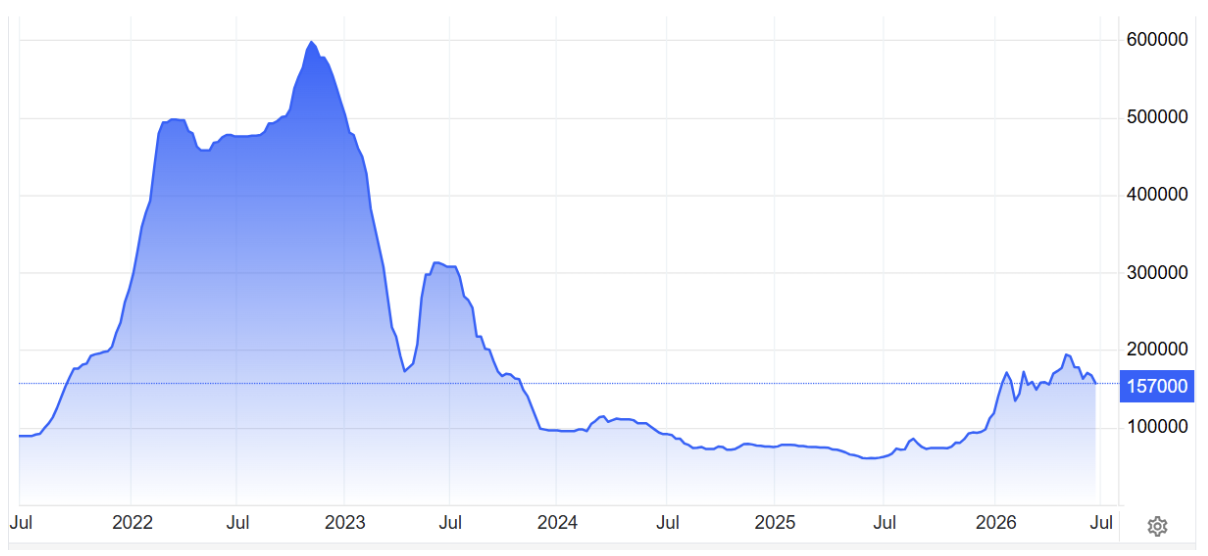
Figure: 5-year fluctuations in the price of lithium carbonate. It shows how the price saw a literal free fall in 2023. This year, 2026, it has started recovering. [Source: Trading Economics]
But time has changed now. By mid-2026, battery-grade lithium carbonate in China staged a strong recovery to roughly $24,710 per tonne. This price recovery was energised by 3 main factors:
- Tighter inventories,
- Delayed mine restarts, and
- Explosive demand from energy storage systems (ESS).
Currently, the lithium carbonate price is hovering around CNY 1,57,000 or a little above $23,000 per tonne.
Project Development Timelines
Hard-rock projects follow two completely separate velocity tracks depending on their initial stage of development:
Brownfield and Suspended Assets (Rapid Track)
- Time to Production: 12 to 18 months.
- Current Activity: Operators with existing infrastructure are making the most of the expected price rebound in 2026. For example, Mineral Resources started operating at its Bald Hill mine in June 2026. This is a move for Mineral Resources. Other companies are also taking action. Core Lithium, for instance, began getting ready to restart at its Finniss asset. The 2026 price rebound seems to be the reason behind these moves. Mineral Resources and Core Lithium are focusing on their mines and assets. They are preparing for what they think will be a 2026.
Greenfield Exploration to First Production (Standard Track)
- The Total Cycle Duration is something like ten to seventeen years. This is how long it takes from the time we first find something to the time we can sell it.
- The Construction and Ramp Duration is three to five years. This starts after we make the investment decision. We use methods like open-pit mining and flotation to get things done.
- The Supply Gap from 2028 to 2030: Greenfield assets usually need about 5 to 7 years to start producing after they are set up. So the recent investment freeze will probably not affect capacity that comes online before 2030. Actually because there was not investment during the bad times there will not be a lot of brand new capacity available before 2030. Greenfield assets will still take time to develop. As a result of this the market might have a supply gap, between 2028 and 2030. Greenfield assets and their development will play a role in this.
Critical Challenges Facing Developers
- The shape of the geological and structural risk ore body is really important because it affects how much it costs to get the ore out. If the orebody is thick and flat, it is a lot easier to extract the ore. This is because there is waste rock to remove. On the other hand, if the ore body is thin and goes straight up, it is much harder to extract the ore. The thin zones of the geological and structural risk orebody have a lot of waste rock mixed in with the ore, which means the ore is not as good. It is harder to get the chemicals out. This results in quality ore and poor chemical recoveries from the geological and structural-risk ore body.
- Severe Financing Bureaucracy: Getting development credit remains highly restrictive. State development banks and commercial lenders demand physical plants or costly letters of guarantee. This leaves pre-revenue developers stuck in the project phase without access to flexible capital.
- High Resource Intensity: Hard-rock processing uses heating, where the temperature gets very high, up to 1,050°C to 1,100°C. This process also uses a lot of energy, about ~2,100 kJ/kg of spodumene. Another method used is acid roasting. When you add this to the heating process, it makes the energy cost of hard-rock processing very high, around 10.4 MJ per unit. It is clear that hard-rock processing uses a lot of energy, water and fossil fuels compared to brine evaporation. Because of this, energy use projects can get into trouble with increasing local carbon taxes and strict ESG rules.
Project Economics for Investors
Evaluating a hard-rock lithium asset requires a meticulous breakdown of capital intensity, margins, and cost curves:
| Economic Metric | Target Performance Range | Investor Implications |
| Capital Expenditure (CapEx) | $1 Billion – $3 Billion for large greenfield builds. | High upfront costs frequently cause heavy shareholder dilution or massive debt loads before first revenue. |
| Target Internal Rate of Return (IRR) | 15% minimum modelled at conservative long-term pricing. | Projects modelling returns below 15% under conservative price tracks struggle to win bankable debt financing. |
| C1 Cash Operating Costs | ~$5,000 per tonne (LCE equivalent) for tier-1 assets. | High-cost operators suffer compressed margins or face suspension when spot markets dip below $10,000. |
| Expected EBITDA Margins | ~37% for high-grade, integrated operations. | Strong structural margins outpace base metals like aluminium, but leave narrow room for processing cost overruns. |
Risk Mitigation Strategies for Investors: What You Should Do to Keep Your Investment Risk-Free
- Prioritise Modular Processing: Research about the companies and seek out developers utilising modular equipment, for example, Dense Media Separation (DMS) plants. Because modular systems drop upfront capital requirements and speed up initial cash flow generation.
- Evaluate Downstream Integration: Pure-play miners selling unrefined spodumene concentrate possess weak pricing power. Target companies building regional refining capacity or partnering directly with major automakers for localised chemical conversion.
- Target the Lowest Cost Quartile: Focus capital strictly on projects positioned in the lowest quartile of the global cost curve. These low-cost operations provide a vital economic cushion against brutal commodity price swings.
Source
- https://tradingeconomics.com/commodity/lithium
- https://source.benchmarkminerals.com/article/volatile-yet-robust-lithium-q1-2026-price-review
- https://www.sunsirs.com/uk/prodetail-1162.html
- https://www.mineralresources.com.au/news/minres-to-restart-bald-hill-lithium-mine/
- https://corelithium.com.au/finniss-lithium-operation
- https://im-mining.com/2026/06/22/portal-cut-at-bp33-deposit-core-lithium-reports/
- https://source.benchmarkminerals.com/article/hard-rock-vs-brine-how-do-their-carbon-curves-compare
Filed under

About the author
Plamen Vasilev
Plamen Vasilev is a writer and language specialist with over 6 years of experience developing informative and engaging content across multiple industries. He combines strong research skills with a deep understanding of finance, mining, technology, and business topics to create well-crafted articles that connect with readers.

