

Key Takeaways
- 01 Capital discipline is reshaping commodity supply curves into 2026.
- 02 AI infrastructure capex is becoming a primary macro variable.
- 03 Central bank policy across AU, CA and US is converging on neutral.
For decades Ottawa stayed out of the mining business. It handed out tax breaks and let the market sort the rest. That ended in the 2025 federal budget.
Minister of Finance, François-Philippe Champagne got up in Parliament on November 4th, 2025 and announced a C$2 billion Critical Minerals Sovereign Fund. That is roughly $1.4 billion in US dollars.
The strategy includes taking an equity position in mining companies, providing loan guarantees and signing offtake agreements for their products.
That last part is the surprise. A government writing cheques for shares in a junior miner is a long way from the old hands-off approach.
Why government mining investment marks a real shift
Most mining money in Canada has chased gold. Look at the numbers and the gap is stark.
In the past 25 years, Canadian miners raised over $700 billion of investment through equity and offtake agreements. 70% of these funds were taken by gold and other precious metals.
Pure critical minerals work? Roughly one dollar in ten, according to RBC’s analysis using S&P Capital IQ data. Australia put more than double that into critical minerals over the same stretch.
So here’s a country with nearly half the world’s listed mining and exploration firms, and it still ships most of its rock raw and lets China refine it. That’s the hole the fund is meant to plug.
The cash targets a specific trap. Industry people call it the “valley of death.” A project proves up a deposit, looks good on paper, then dies because no one will fund the gap between drilling success and a working mine. Banks see the risk and walk. The fund steps into that gap.
Natural Resources Canada runs the show. The department gets C$50 million over five years just to set the thing up.
What the Canada sovereign wealth fund minerals plan actually pays for
The fund works through three tools. None of them are grants.
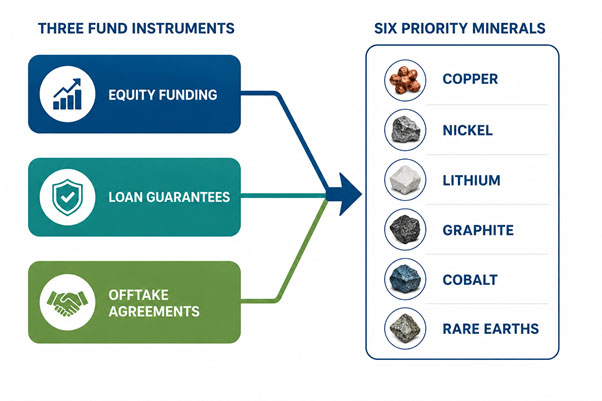
How the Critical Minerals Sovereign Fund moves money into the six minerals Canada wants most
- Equity funding – the government buys shares and rides the upside and the downside with private backers
- Loan guarantees – Ottawa backstops the debt so lenders charge less
- Offtake agreements – the state agrees to buy the output, giving a project guaranteed revenue
Individual cheques are expected to run from C$5 million to over C$100 million per company, based on Natural Resources Canada program guidance reported in early 2026. That makes it the biggest equity-based critical minerals program the country has run.
There are six minerals that lead the pack: copper, nickel, lithium, graphite, cobalt, and rare earth elements. All six are ones China largely controls. All six feed batteries, defence kit and the power grid.
There’s a catch worth flagging. As Peter Clausi of the Critical Minerals Institute put it, “the devil’s in the details.” When the fund was announced, nobody knew whether the money leaned toward exploration, production or processing.
That mattered, because processing is exactly where Canada is weakest.
How the fund fits a much bigger push
The sovereign fund doesn’t stand alone. It’s one piece of a spending wave.
At the PDAC convention in Toronto on 3 March 2026, Energy Minister Tim Hodgson laid out more than C$3.6 billion in new programs. He confirmed the sovereign fund would open for applications in spring 2026.
He also launched a C$1.5 billion First and Last Mile Fund to build the roads and power lines that strand remote deposits.
The day before, Hodgson signed 30 deals worth about C$12.1 billion with 12 allied nations. He framed it bluntly, calling critical minerals “central to global power and national sovereignty” at a time of “rupture in the world order.”
That language tells you the real driver. This isn’t only about jobs. Champagne wants Canada to be the “NATO partner of choice” for the minerals that go into submarines, radar and missiles. Titanium for subs. Tungsten for ammunition. Rare earths for guidance systems.
Refining is the bit he keeps hammering. “Exploration, extraction is something. But what we need is refining. That’s the key,” he told a Calgary audience.
Right now Canada mines the stuff and ships it south or to Asia. The value-add happens elsewhere. The fund is a bet on keeping more of that chain at home.
What ASX and TSX investors should watch
For anyone holding mining stocks, the read-through is direct. Government equity tends to pull private money in behind it. A project with Ottawa on the register looks safer to the next investor.
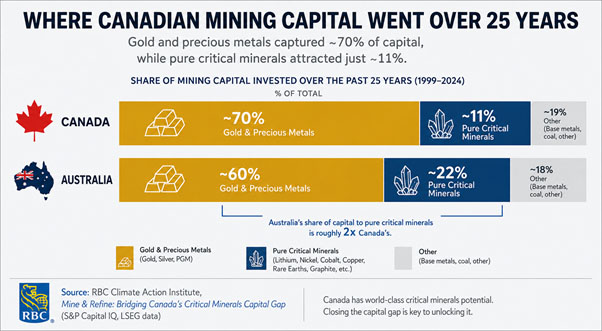
Canadian mining money has long favoured gold over critical minerals, while Australia backed critical minerals at more than twice the rate
That said, the fund is modest against the scale of the task. C$2 billion sits at roughly 1.8% of what mining contributes to Canada’s economy each year.
Canada’s mining sector adds about C$117 billion to GDP and makes up 21% of exports. The fund is seed capital, not a flood.
Australian-listed companies with Canadian ground should pay attention. Foreign-listed firms with real Canadian operations may qualify once the rules firm up.
Sayona Mining, now trading as Elevra, already runs the North American Lithium operation in Quebec that ministers keep using as the poster child.
The budget still has to clear Parliament, where Mark Carney’s government holds a minority. So a slice of this remains a promise rather than a cheque.
But the direction is set, and it puts Canada on the same path the United States took with the Inflation Reduction Act and the European Union with its own raw materials push.
FAQs
Q: What is the Critical Minerals Sovereign Fund of Canada?
A: A C$2 billion fund created by the government to support mining projects through equity, loan guarantees, and offtake agreements.
Q: When does the fund open?
A: Applications are expected in spring 2026.
Q: Which minerals does it target first?
A: Copper, nickel, lithium, graphite, cobalt and rare earth elements.
Q: Who runs it?
A: Natural Resources Canada.
Q: Can Australian-listed companies apply?
A: Foreign-listed firms with substantial Canadian operations may qualify once rules are finalised.
Disclaimer: This article is for general information only and does not constitute financial or investment advice. Mining Herald is not a licensed financial adviser. Figures relating to government funding and company operations are sourced from public announcements and should be independently verified before any investment decision. Share market investments carry risk. Always consult a licensed professional before acting.
Filed under

About the author
Plamen Vasilev
Plamen Vasilev is a writer and language specialist with over 6 years of experience developing informative and engaging content across multiple industries. He combines strong research skills with a deep understanding of finance, mining, technology, and business topics to create well-crafted articles that connect with readers.