


Key Takeaways
- 01 Capital discipline is reshaping commodity supply curves into 2026.
- 02 AI infrastructure capex is becoming a primary macro variable.
- 03 Central bank policy across AU, CA and US is converging on neutral.
Nickel has been doing the unglamorous work of holding industrial civilisation together for over a century. Most people never think about it once. The stainless steel bench in a hospital operating theatre, the pipeline carrying fuel across a continent, the kitchen sink that has not rusted in twenty years, nickel is behind all of it.
 Figure 1: Open-pit nickel mining operation illustrating large-scale extraction activities that support global nickel supply [Courtesy: Market Research Intellect]
Around 70 per cent of the world’s nickel still ends up in stainless steel. It holds up where other metals give out. It performs under extreme heat where others deform. It extends the working life of structures that the modern world depends on. That industrial role alone would make nickel worth watching. But that is only half the story now.
The Newer Story Is Where Things Get Interesting
But the industrial backbone is only part of what nickel does now. All characteristics that make nickel apply to industrial steel: its electrochemical stability, its energy density and the fact that it can hold a charge more efficiently than other materials, also render it one of the most important features in lithium-ion battery technology.
The battery with the highest nickel content stores more energy per kilogram than the one without. That is huge for electric vehicles, where range anxiety is still an actual consumer concern, and especially at grid-scale energy storage, where density and cost per kilowatt-hour decide whether a project even gets built.
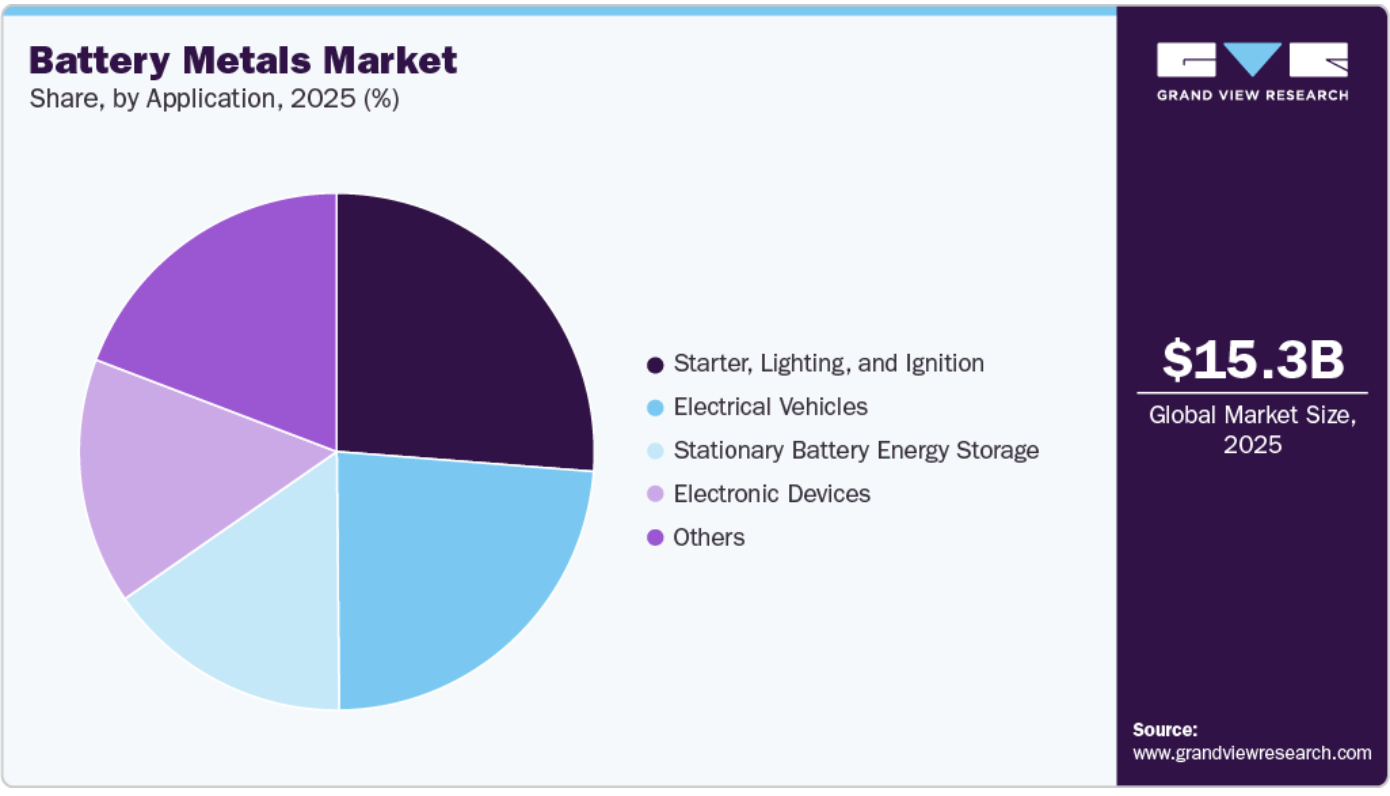 Figure 2: Global battery metals market share by application in 2025, highlighting demand across electric vehicles, energy storage, and electronics [Courtesy: Grand View Research]
There is also the defence angle that rarely gets discussed openly. Nickel is a critical input in superalloys used in jet engines, naval vessels, and armoured vehicles. Several Western governments now classify it as a strategic mineral for that reason alone, separate from the battery conversation entirely.
The global nickel market was worth US$47.8 billion in 2025. By 2034, that number is projected to hit US$78.3 billion, growing at 7.30 per cent a year.
 Figure 3: Global nickel market outlook showing projected growth from US$47.8 billion in 2025 to US$78.3 billion by 2034 [Courtesy: Fortune Business Insights]
The battery metals market sits at US$15.3 billion today and is heading toward US$22.6 billion by 2033. Canada is not on the sidelines of this. It is directly in the path of the capital.
 Figure 4: Battery metals market forecast by metal type from 2023 to 2033 [Courtesy: Grand View Research]
Why Nickel Is Getting Serious Attention Again
Indonesia is the reason this conversation is happening right now. Indonesia provides roughly 65 per cent of the world’s nickel. It established annual ore production quotas at 250 to 260 million metric tonnes as of the start of 2026.
At the same time, smelter demand is at 340 to 350 million metric tonnes. Do the maths. That is short 80 to 100 million metric tonnes. When the world’s dominant supplier starts running short of its own ore, the rest of the market pays attention quickly.
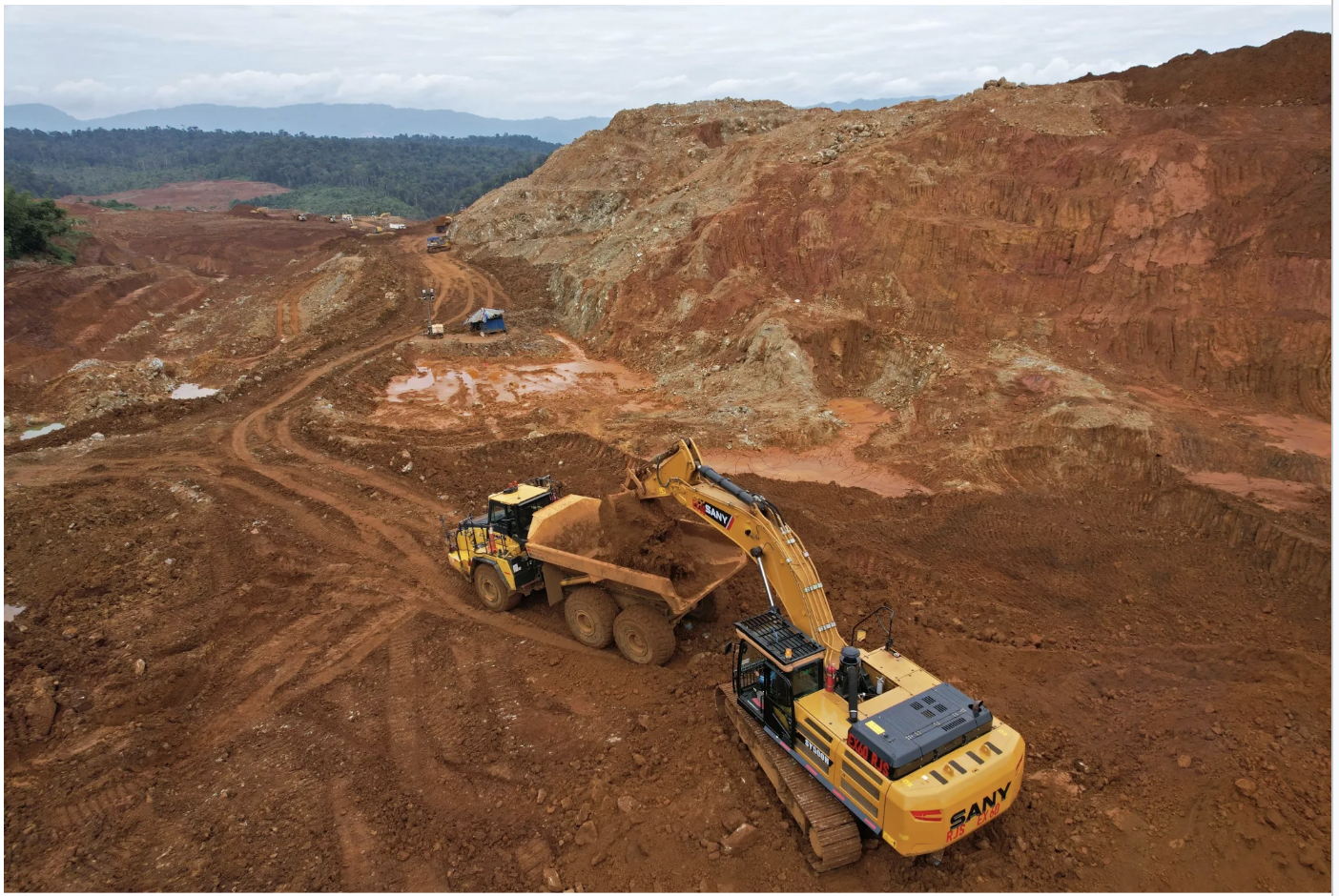 Figure 5: Nickel mining activity in Indonesia, the world’s largest nickel-producing nation and a key driver of global market dynamics [Courtesy: Bloomberg]
The LME three-month nickel contract was trading at around US$17,386 per tonne as of 18 Feb 2026. That is up 3.61 per cent on the day and a long way from the US$14,235 per tonne low it touched in mid-December 2025.
Crux Investor analysts have US$20,000 per tonne in their sights as a near-term target. US$22,000 per tonne is on the table later in the decade if grade constraints tighten as expected.
The U.S. Government Is Now a Buyer
This is the part most people have not fully registered yet. On 02 Feb 2026, the U.S. government launched Project Vault. It is a US$12 billion strategic critical minerals stockpile, backed by a US$10 billion Export-Import Bank loan and US$1.67 to US$2 billion in private capital. Nickel is on the list. So are lithium, cobalt, rare earths, and graphite.
What this means practically is that Western, allied-jurisdiction producers now have a creditworthy government buyer, and Canada qualifies. The initiative specifically targets battery-grade Class 1 nickel and nickel sulphate, and its entire purpose is to reduce dependence on Chinese-controlled battery supply chains. Selling into that is a different proposition than chasing spot prices on a volatile exchange.
Industry Outlook
According to the International Energy Agency, Electric vehicles made up over 70 per cent of total global lithium-ion battery deployment in 2025. As for worldwide EV sales, these surged about 30 per cent throughout 2025, crossing the 20 per cent mark of all new cars sold globally.
 Figure 6: Battery metals market segmentation by region, application, and metal type [Courtesy: Grand View Research]
According to the IEA’s 2025 Critical Minerals Outlook, nickel battery material demand is on track to grow at more than 20 per cent annually through 2030 across every net-zero scenario modelled. Supply deficits are expected to land somewhere in the 2028 to 2030 window. That is not a distant problem.
Canadian Nickel Mining Investment: The Companies Worth Watching
Canada’s nickel pipeline is not built around one name. It runs from near-production growth to early-stage explorers working on geology that most of the market has not priced in yet. Here is where the attention is going.
 Figure 7: Refined nickel metal bars used in battery manufacturing, stainless steel production, and industrial applications [Courtesy: ET]
Talon Metals (TSX: TLO)
Rather than sit passively on the sidelines, Talon Metals wasted no time in swooping in and acquiring Lundin Mining’s Eagle Mine and Humboldt Mill in Michigan on 09 Jan 2026. That acquisition transformed it into an overnight multi-asset, U.S. nickel-copper producer with cash flows coming in.
Canada Nickel Company (TSXV: CNC)
Canada Nickel Company sits behind the Crawford Nickel Sulphide Project in Ontario, which carries the distinction of being the world’s second-largest nickel resource and reserve. The March 2025 feasibility study update put the after-tax NPV 8 per cent at US$2.8 billion with an IRR of 17.6 per cent.
In January 2026, Crawford was brought into Ontario’s One Project, One Process framework, which is the kind of regulatory signal that moves timelines from possible to probable.
Final permits are targeted for H1 2026, with a construction decision expected late 2026. The carbon sequestration angle through tailings mineralisation adds something real for institutional investors with ESG mandates.
FPX Nickel (TSXV: FPX)
FPX Nickel is pushing the Baptiste Nickel Project, British Columbia. It has the largest undeveloped nickel deposits in the world. This sits behind a low-carbon production case with progress on drilling in 2025, environmental assessment, government grants and First Nations partnerships. Few projects in the world have that scale, much less that quality of jurisdiction.
First Atlantic Nickel Corp. (TSXV: FAN)
This one is worth understanding properly before the rest of the market does. First Atlantic Nickel Corp. is developing the Pipestone XL Nickel-Cobalt Alloy Project in North America. The target mineral is awaruite.
Awaruite (Ni₃Fe) is not something you find at every nickel project. Basically, a naturally magnetic nickel-iron alloy formed millions of years ago with no sulphur in it. It took place, over time, deep in the earth and involved water reacting with ancient mantle rock, serpentinisation.
 Figure 8: Awaruite mineral illustration from the Pipestone XL Project [Courtesy: First Atlantic Nickel Corp.]
The iron and nickel, freed from the host rock through that reaction over geological timescales, crystallised into a dense metallic alloy. No smelter made it. No refinery touched it. It arrived at the surface already in a reduced metallic state, ready to work.
Cobalt averaged 1.69 per cent and peaked at 6.05 per cent. For context, high cobalt grades in awaruite are rare globally. Most occurrences do not come close. These are the kinds of numbers that make geologists look twice.
Magna Mining (TSXV: NICU) and Nickel 28 Capital (TSXV: NKL)
Magna Mining gives exploration exposure in the Sudbury Basin. Nickel 28 Capital is the royalty and streaming play for investors who want nickel leverage without taking direct project risk. Both serve different purposes within a Canadian nickel mining investment portfolio, depending on what you are trying to do.
What the Price Forecasts Actually Say
- Trading Economics, as of 19 Feb 2026, has nickel averaging around US$17,159 per tonne by the end of Q1 2026, rising to US$18,346 over 12 months
- Crux Investor is targeting US$20,000 to US$22,000 per tonne if Indonesian supply discipline holds
- Greenfield incentive pricing for new Class 1 nickel supply sits at US$22,000 to US$28,000 per tonne across the industry
A move from US$17,000 to US$22,000 per tonne does not translate linearly into share price. But for producers with all-in sustaining costs below US$12,000 to US$14,000 per tonne, the margin expansion is material.
The Risks Are Real Too
Indonesia retains a very strong position in the effective monopoly of shipments, controlling over two-thirds of the world’s supply. Well, the problem of permitting in Canada and the U.S. moves at all, even when governments talk about fast-tracking it.
The inflation in capital expenditure for new projects has been at 15 to 20 per cent year after year. Battery chemistries are on the way to improve, and a long-term move to LFP or perhaps large nickel thrifting would blunt demand growth.
Nickel equities move sharply. Most resource investors keep the sector at 3 to 8 per cent of a portfolio. The point is not to avoid it. The point is to know which assets at which stage you are actually buying.
Final Thought
The geology in Canada was always there. What 2026 brought was the policy environment, the supply discipline, and a government buyer. When a national government starts stockpiling a commodity as a matter of security, the investment stock picks calculus shifts. That is not a cycle call. That is a structural change.
From Talon Metals and Canada Nickel Company near the production end, to First Atlantic Nickel Corp. working on awaruite that most of the market still does not fully understand, the Canadian nickel pipeline is deeper than it looks from the outside. The investors who figure that out before the headlines arrive tend to get the better entry points.
FAQ
Q1. What is Canadian nickel mining investment?
Ans. It refers to capital directed toward nickel exploration and production companies operating in Canada.
Q2. Why does Indonesian supply discipline matter?
Ans. Indonesia faces an 80 to 100 million metric tonne supply shortfall in 2026, tightening global nickel supply and boosting Western producers.
Q3. What is Project Vault?
Ans. A US$12 billion U.S. government critical minerals stockpile launched on 02 Feb 2026 that explicitly includes battery-grade Class 1 nickel.
Q4. What is awaruite?
Ans. A naturally occurring nickel-iron-cobalt alloy that skips smelting and acid leaching entirely. First Atlantic Nickel Corp. is targeting it at the Pipestone XL Project.
Disclaimer
This article is intended for informational purposes only. If you pay attention to the Canadian nickel space as an investor, then all the data in the content is from third-party sources. Please check out the complete share price and market data info. Investing carries a high risk, and you should only invest at your own risk. Mining Herald has no involvement in the above-listed companies.
- https://www.grandviewresearch.com/industry-analysis/battery-metals-market
- https://www.fortunebusinessinsights.com/nickel-market-106576
- https://www.canadianminingreport.com/blog/nickel-market-surge-drives-investment-opportunities-in-mining-stocks
- https://www.mining.com/region/canada/
- https://www.newswire.ca/news-releases/critical-minerals-market-heats-up-as-nickel-and-cobalt-demand-surges-worldwide-844042412.html
Filed under

About the author
Plamen Vasilev
Plamen Vasilev is a writer and language specialist with over 6 years of experience developing informative and engaging content across multiple industries. He combines strong research skills with a deep understanding of finance, mining, technology, and business topics to create well-crafted articles that connect with readers.