
Key Takeaways
- 01 Shareholders strongly endorsed the board and new CEO Brandon Craig
- 02 Underlying attributable profit rose 30% to US$13 billion in FY2026
- 03 Copper contributed more than half of earnings for the first time
- 04 The company returned ~A$2.40 per share in dividends
BHP held its annual meeting in Sydney on Thursday 22 October. Every board-backed resolution passed, and the one outside candidate got hammered.
It was Brandon Craig’s first AGM as chief executive. He took the top job on 1 July after more than 25 years at the company.
Chair Ross McEwan opened with safety, not profit. Two workers have died on site in recent months, one at Peak Downs in Queensland and one at Escondida in Chile.
The BHP shareholder vote was never close
Craig won 99.58% support, and new director Mark Vassella won 99.44%.
The remuneration report passed with 98.09% in favour, and Craig’s equity grant cleared with 98.97%.
| Resolution | Result |
|---|---|
| Elect Brandon Craig | 99.58% for |
| Elect Mark Vassella | 99.44% for |
| Remuneration report | 98.09% for |
| CEO equity grant | 98.97% for |
| Elect Stephen Mayne (outside candidate) | 98.90% against |
BHP’s 2026 AGM poll results on the key resolutions, 22 October 2026. Source: BHP AGM poll results announcement.
Stephen Mayne was the exception. He nominated himself for the board, and 98.90% of votes cast went against him.
Mayne had raised concerns about hybrid AGMs and whether smaller investors get enough access to management. The board told shareholders to vote no in its Notice of Meeting. He has tried before, back in 2008.
My read is simple. The board election outcomes show investors are happy with the dividend, the share price and the new boss. A result like that is not a governance scare.
But the hybrid question has not gone away. BHP says it has more than 600,000 shareholders, and a room in Sydney holds a tiny slice of them.
BHP copper earnings now outweigh iron ore
Copper made up 54% of underlying EBITDA in FY26, or more than US$18 billion, at a 70% margin.
Iron ore still generated more than US$14 billion. That would be a monster result for most miners. It just came second.
BHP’s underlying profit growth was 30%, to US$13.2 billion. Underlying EBITDA rose 27% to about US$33 billion.
The full-year dividend came in at US$1.72 a share, or US$8.7 billion, the highest in four years.
Here is what the headline leaves out. Price did most of the lifting. Realised copper prices jumped 35% while production slipped 3%, to about 1.9 million tonnes.
Statutory profit tells a plainer story. It rose 9% to US$9.8 billion after a US$2.3 billion non-cash impairment tied to Jansen. That makes the BHP FY26 performance strong, but not spotless.
Copper volumes fell 19% in the September quarter
Two days before the AGM, BHP released its first-quarter operational review. Copper output was 400.7kt, down 19% on the same quarter last year.
BHP blamed lower planned grades, maintenance, bad weather in Chile, a safety stop at Escondida and a conveyor failure at Carrapateena.
Escondida’s feed grade averaged 0.81%, against 0.94% a year earlier. Full-year guidance assumes about 0.70%.
Guidance did not move. BHP still expects 1.65 to 1.8 million tonnes of copper in FY27.
Run that quarter four times, and the answer is about 1.6 million tonnes, under the bottom of the range. The second half has work to do, and Spence volumes are already weighted that way.
Price is covering the gap. The average realised copper price was US$7.01 a pound, up 53%.
Rough maths on BHP’s own sales and price figures puts copper revenue about 40% higher than a year ago, on 7% fewer tonnes sold. That is a ballpark only, because the price figure leaves out equity-accounted sales.
So BHP is earning more from less copper. That works while the price holds. After the August result, the shares looked around 40% above its intrinsic assessment. For anyone tracking copper stocks on the ASX, that gap is the thing to watch.
Iron ore holds the line, and Jansen is the next test
BHP iron ore production rose 4% to 66.5Mt, with September-quarter records at both the Pilbara mine and the port.
That came during a rebuild of Car Dumper 4 at Port Hedland, which cost 1.4Mt on a 100% basis. The realised price fell 9% to US$76.27 a tonne. More tonnes, lower price, the mirror image of copper. The wider iron ore market will decide how long that lasts.
Then there is Jansen, the Canadian potash project. Stage 1 is 87% complete, with first production due in mid-2027.
Craig did not dress it up at the meeting. He said, “Jansen has taken longer and cost more than we originally planned.”
The quarterly report also did something quieter. It reported a first-ever block cave resource at Olympic Dam of 10,730Mt at 0.59% copper. BHP has not converted any of it to reserves and says the timeframe is not yet known.
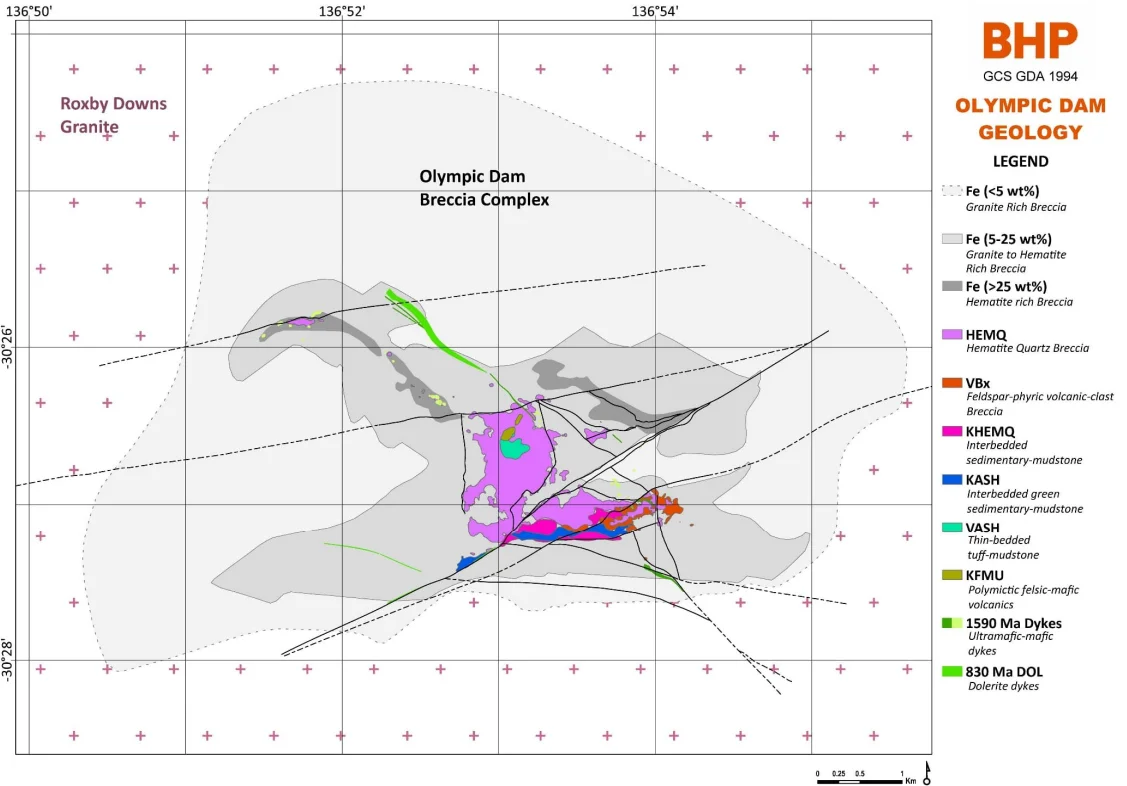
Simplified geological plan of the Olympic Dam deposit, approximately 350 m below surface. [BHP]
My view: the AGM was the easy part of Craig’s year. Copper tonnes need to climb in the second half, and potash has to start on time. If either slips, a lot of weight lands on the copper price, and ASX mining stocks have a long record of getting burned when prices change their minds.
FAQs
Q: When was the BHP AGM in 2026?
A: Thursday 22 October 2026, in Sydney.
Q: Were all BHP directors re-elected?
Every board-endorsed director passed, including new CEO Brandon Craig.
Q: Who is Stephen Mayne?
A long-time shareholder activist who nominated himself for BHP’s board and lost heavily.
Q: How much of BHP’s FY26 earnings came from copper?
Copper made up 54% of underlying EBITDA, about US$18.2 billion.
Q: Did BHP change its FY27 guidance?
No. Copper guidance stays at 1.65 to 1.8 million tonnes.
Disclaimer: This article is general information only and is not financial advice. It does not consider anyone’s objectives, financial situation or needs. Readers should do their own research or speak with a licensed adviser before making investment decisions.
Filed under

About the author
Jonathon Brown
Jonathon Brown began his career as a broadcaster, working across markets in British Columbia before moving into financial journalism. Since 2017, he has specialised in stock market reporting, covering emerging companies across the healthcare, technology, mining and consumer sectors. He brings more than 15 years' experience to his reporting. A graduate of Vancouver Island University and the British Columbia Institute of Technology, Jonathon is focused on delivering clear, balanced reporting for investors.