

Key Takeaways
- 01 Brightstar has named 11 new Two Mile Hill-style targets at Sandstone, with RC drilling on the first ready ones due to start this month.
- 02 Seven targets are drill-ready, but the other four still need gravity or field work first.
- 03 The Two Mile Hill resource update and the Sandstone PFS are both due by the end of the December quarter.
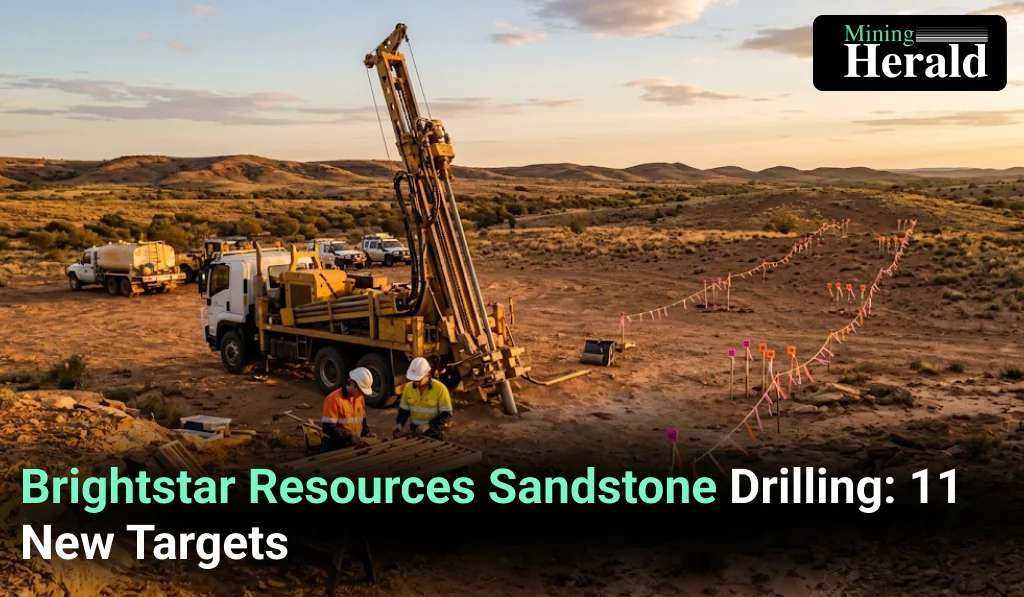
Brightstar Resources will start RC drilling at its Sandstone gold project this month after naming 11 new targets.
Brightstar Resources (ASX: BTR) put the list out on 4 November in an ASX announcement. All 11 sit on the ground between its Two Mile Hill and Bull Oak deposits.
Those two deposits already make up about half of Sandstone’s resource. Both sit inside the same rock type, a felsic intrusive, which is a lump of granite-type rock that squeezed into older basalt and banded iron.
The plan is simple. Find more rock like it, then drill it.
Brightstar’s Sandstone drilling starts with seven ready targets
Not all 11 are at the same stage. Seven list RC drilling as the next step: Twin Shafts, Bullet, Mt Klempt, Mt Klempt South, Workers Granite, Welcome Granite and Iron Duke.
The other four still need groundwork. Ammirati, Turley, Peanut and Freedom wait on a gravity survey, field checks or early tests, and Peanut is so far just a potassium signal in radiometric data.
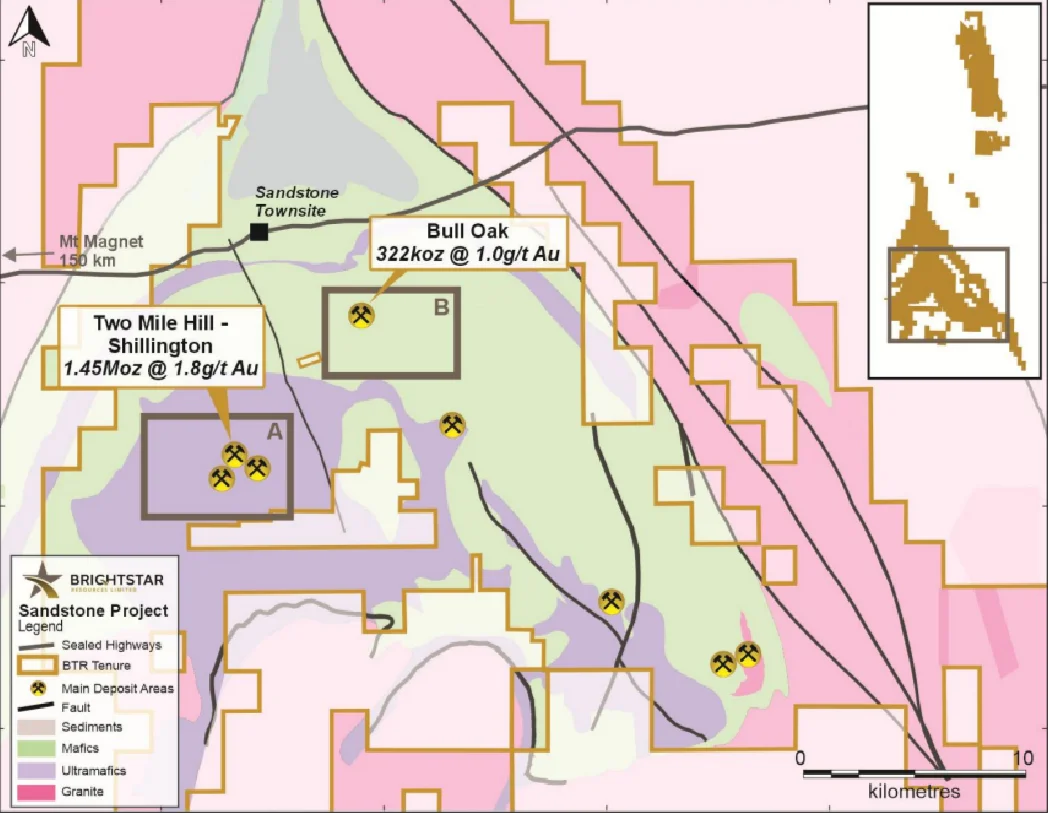
Targeting areas between the Two Mile Hill and Bull Oak deposits at Sandstone. [BTR]
The best old hits behind the ready group:
- Mt Klempt South: 9m at 2.70g/t gold from 16m, including 1m at 19.4g/t
- Twin Shafts: 4m at 7.74g/t from 50m
- Workers Granite: 9m at 1.99g/t from 22m
- Mt Klempt: 22m at 0.66g/t from 73m, in a hole that ended while still in gold
The picking recipe is plain. Each target sits where a gravity low lines up with granite in old drill logs and gold in soils or old holes. A gravity low hints at lighter rock sitting inside heavier basalt.
Bullet and Mt Klempt South are roughly 2km south of Two Mile Hill. Testing next to a known orebody is cheap, because the geology, tenure and access are already sorted.
Half the ounces come from one rock type, but the grades differ
Two Mile Hill-Shillington holds 1.45Moz at 1.8g/t. Bull Oak holds 322,000oz at 1.0g/t. (Moz means million ounces.)
Same rock, very different grade. Managing Director Alex Rovira says this deposit style shows “scale and grade potential”. Those are two separate claims, though, and the release does not say which one the company hopes to find.
A new intrusive that behaves like Bull Oak is a bulk-tonnage story. One that behaves like Two Mile Hill would be richer.
Recent drilling shows both flavours. Two Mile Hill returned 226m at 3.11g/t from 284m, and a deeper hole cut 305m at 1.33g/t from 584m. Bull Oak gave 167m at 2.07g/t from 104m.
One detail in the resource table gets less airtime. Of the 3,583koz at Sandstone, 2,104koz (about 59%) sits in the Inferred category. At Two Mile Hill-Shillington it is 920koz of 1,446koz, or about 64%.
Inferred is the least certain class under the JORC Code and cannot turn straight into reserves. The pre-feasibility study due this quarter leans on those ounces.
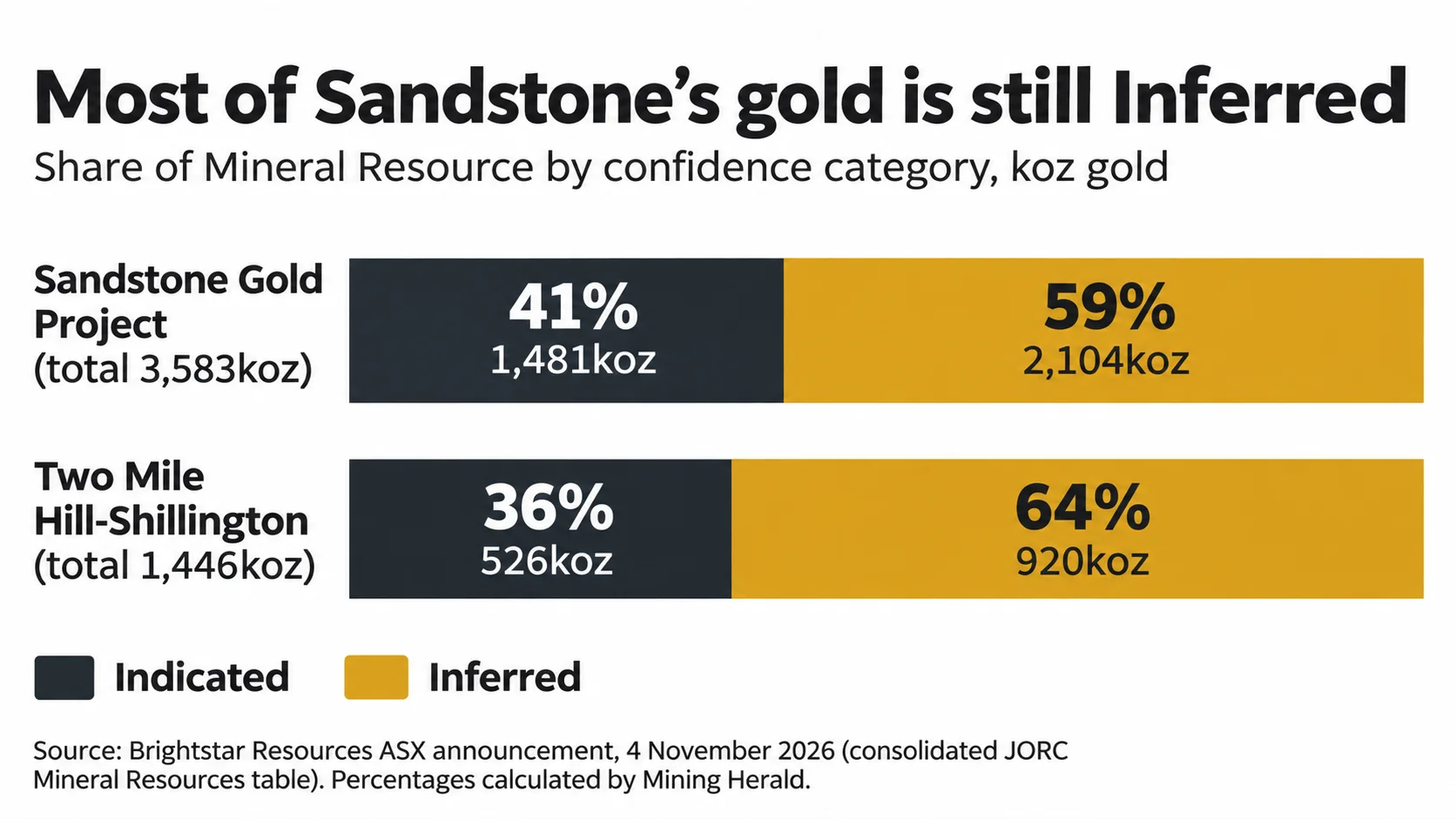
About 59% of Sandstone’s resource and 64% of Two Mile Hill-Shillington is Inferred.
The old holes behind the list are shallow and rough
Most of the evidence comes from drilling done decades ago by earlier owners such as Herald and Troy. It was mostly RAB, a cheap rotary air blast method, with samples often mixed into 4m or 5m composites.
Take Twin Shafts. That 4m at 7.74g/t came from hole TS333R, a vertical RAB hole only 72m deep.
The lab method was aqua regia, which the company’s own notes call a partial extraction. Gold locked in some sulphides may not fully dissolve, so old numbers can read low.
Gravity adds its own trap. A low can mean granite, but it can also mean thick sediment or deep weathering.
So the first RC holes mostly ask one question. Is there an intrusive here, and does it carry gold?
Some will come back empty. That is normal for first-pass work, and one good hit can reset the story.
Rigs, assays and a study all fall due before year end
Besides the RC start, assays from diamond holes TMHDD26004, 26005 and 26006 at the Shirvington Zone are due in November. The updated Two Mile Hill resource and the Sandstone pre-feasibility study (PFS) are also due this quarter, the company says.
The release leaves out metres, hole numbers and a date for the first RC assays. That makes the size of the November program hard to judge.
Behind all this sits a second story. Brightstar’s Goldfields Project has a January 2026 study showing more than 75,000oz a year over six years, an A$606m NPV8 and a 74% IRR. The 1.5Mtpa plant is under construction, with first gold targeted for the June 2027 quarter.
Goldfields is the build. Sandstone is the part that still has to prove itself.
A study is only as good as its inputs, so our guide on how to evaluate a mining company’s feasibility study is worth a read before the PFS lands.
Other explorers face the same question of whether a good zone keeps going. Novo Resources, for one, wants to know if its higher-grade zone runs far enough north at Clone, as covered in its latest gold exploration update.
Moves in the metal itself, like the recent slide in gold and silver prices, change how the market treats drilling news. More sits in Mining Herald’s gold news section.
FAQs
Q: What did Brightstar announce on 4 November 2026?
A: It named 11 new felsic intrusive targets at Sandstone and said RC drilling starts this month.
Q: When does the RC drilling start?
A: Later in November 2026, per the company.
Q: How big is the Sandstone gold resource?
A: 3.6Moz at 1.4g/t gold.
Q: What is a felsic intrusive?
A: A body of light-coloured igneous rock, such as tonalite, that cooled underground.
Q: Is Brightstar producing gold yet?
A: No. First gold from Goldfields is targeted for the June 2027 quarter.
Disclaimer:
General information only. This article is not financial product advice and does not consider the objectives, financial situation or needs of any individual. Seek advice from a licensed financial adviser before making any investment decision. Mining Herald or an associate may have commercial arrangements with companies it covers.
Filed under

About the author
Jonathon Brown
Jonathon Brown began his career as a broadcaster, working across markets in British Columbia before moving into financial journalism. Since 2017, he has specialised in stock market reporting, covering emerging companies across the healthcare, technology, mining and consumer sectors. He brings more than 15 years' experience to his reporting. A graduate of Vancouver Island University and the British Columbia Institute of Technology, Jonathon is focused on delivering clear, balanced reporting for investors.