

Key Takeaways
- 01 Capital discipline is reshaping commodity supply curves into 2026.
- 02 AI infrastructure capex is becoming a primary macro variable.
- 03 Central bank policy across AU, CA and US is converging on neutral.
All mining projects originate from simple concepts in the head of a geologist. Teams investigate prior logs and search for unusual chemical markers found in soil. The knowledge they acquire forms the first mining exploration sites.
Companies test these targets systematically. They secure land access and apply for exploration licences first. Approvals allow field crews to walk the tenement to map rocks and take surface samples.
Planes fly overhead with magnetic sensors to look deep underground. Fieldwork validates the initial theory without spending millions of dollars. Finding physical proof of mineralisation remains the main goal at this stage.
Drill Programmes and Target Testing
Good surface data brings the drill rigs to the site. Early scout drilling checks if the surface anomalies continue at depth. Crews extract rock core, lay it out in trays, and record every geological detail.
The rock samples ship off to independent laboratories for assaying. Quality control is everything right now. Geologists add blank rocks and duplicate samples to the shipments just to keep the assay labs honest.
Bad sampling practices ruin future geological models. Clean assay data proves the discovery is genuine. Management uses this proof to fund tighter, more expensive infill drilling.
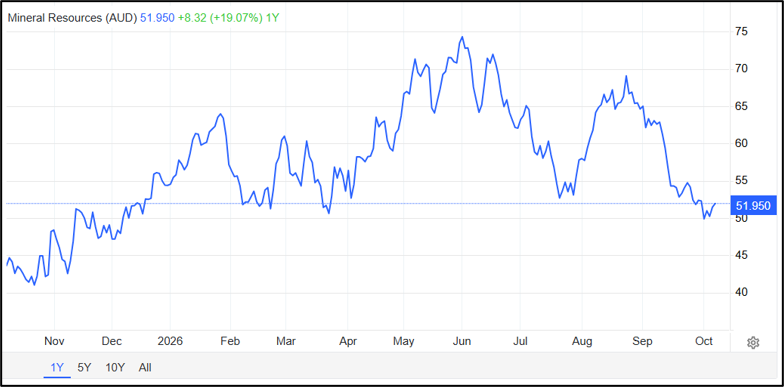
Fig 1: Mineral Resources (AUD) share price chart [tradingeconomics]
Defining the Mineral Resource Estimation
Drill data populates a 3D block model on a computer screen. Geologists use the software to draw boundaries around the ore. They run complex statistics to see exactly where the high-grade metal sits.
This work delivers the formal mineral resource estimation. The resulting report groups the rock into Inferred, Indicated, or Measured categories. More drill holes simply mean higher confidence in the numbers.
Regulators force listed companies to follow strict reporting codes like JORC. A compliant statement tells the market exactly what the company has found. Management takes these numbers to the board to justify feasibility spending.
Moving Through Feasibility Studies
Finding metal means nothing if you cannot mine it profitably. The project faces serious economic hurdles next. Engineers look at the rock to see if they can dig it out safely.
Metallurgists conduct testing of the rock in labs. Some minerals can be extracted from the ore using a simple crushing machine while some rocks will need expensive chemical treatment. Environmental companies watch the local plants and animals in order to get ready for government licensing.
Water experts study the local aquifers to plan the mine pumps. Mining engineers draw up the actual pit design. The shape of the ore body tells them whether to dig an open pit or go underground.
Upgrading to Mineable Resources
Feasibility work answers one core question. Will this dirt make money? Planners apply modifying factors to the resource model to find out.
They factor in mining costs, metal prices, and recovery rates. Adding these real-world constraints converts a geological estimate into actual mineable resources. Industry professionals call these final numbers Ore Reserves.
Ore Reserves represent the parts of the deposit that guarantee a profit. Banks look at these figures before they lend any construction capital. A green light here launches the development phase.
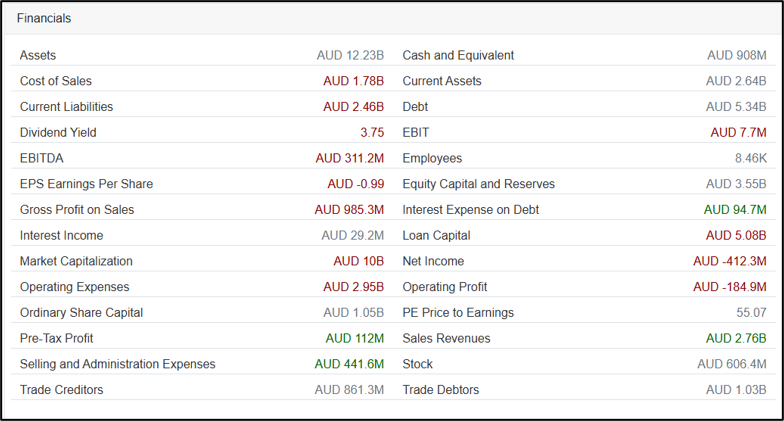
Fig 2: Financials mining [tradingeconomics]
Mine Construction and Production
The moment funds are released for the project, development activities kick start. Equipment starts arriving to construct the processing plant as well as to create the access roads. Human resources work begins with hiring of permanent personnel.
Start-up begins right after construction finishes. The plant crushes its first tonnes of rock. Geologists map the daily dig faces so the trucks only haul profitable ore to the mill.
Planners compare the mined grades against their original computer models every single day. This reality check keeps production on target. The risky exploration play finally becomes a steady, cash-producing business.
Handling Depletion and Mine Closure
Every mine runs out of ore eventually. Operations enter depletion when the diggers reach the edge of the known reserve. Management faces a major choice at this stage.
They either spend money looking for more rock or shut the site down. Brownfields exploration targets areas right next to the current pit. Finding more metal nearby keeps the existing plant running for a few more years.
A dry drill hole forces the company to execute its closure plan. Earthmoving teams reshape the land and plant native seeds. The company monitors the water table for years to prove the environment is safe.
FAQ
What makes mining exploration targets valuable to shareholders?
These targets offer the initial technical proof of a potential discovery, laying the groundwork for drill campaigns that add real value.
Why is mineral resource estimation critical for project funding?
It provides a data-driven, compliant calculation regarding the grade and size of the ore body, which financiers demand before handing over any capital.
When do geological discoveries officially become mineable resources?
This only happens after exhaustive feasibility studies demonstrate that the rock can be mined, processed, and sold for a definite profit.
Disclaimer
This article is meant only for informational purposes. If you are an investor who is watching mineral resources closely, all the data published in the content is sourced from announcements and external sources. Kindly verify all information related to the share price and market data. Any investment should be made at the investor’s own risk.
Filed under

About the author
Jonathon Brown
Jonathon Brown began his career as a broadcaster, working across markets in British Columbia before moving into financial journalism. Since 2017, he has specialised in stock market reporting, covering emerging companies across the healthcare, technology, mining and consumer sectors. He brings more than 15 years' experience to his reporting. A graduate of Vancouver Island University and the British Columbia Institute of Technology, Jonathon is focused on delivering clear, balanced reporting for investors.