

Key Takeaways
- 01 Capital discipline is reshaping commodity supply curves into 2026.
- 02 AI infrastructure capex is becoming a primary macro variable.
- 03 Central bank policy across AU, CA and US is converging on neutral.
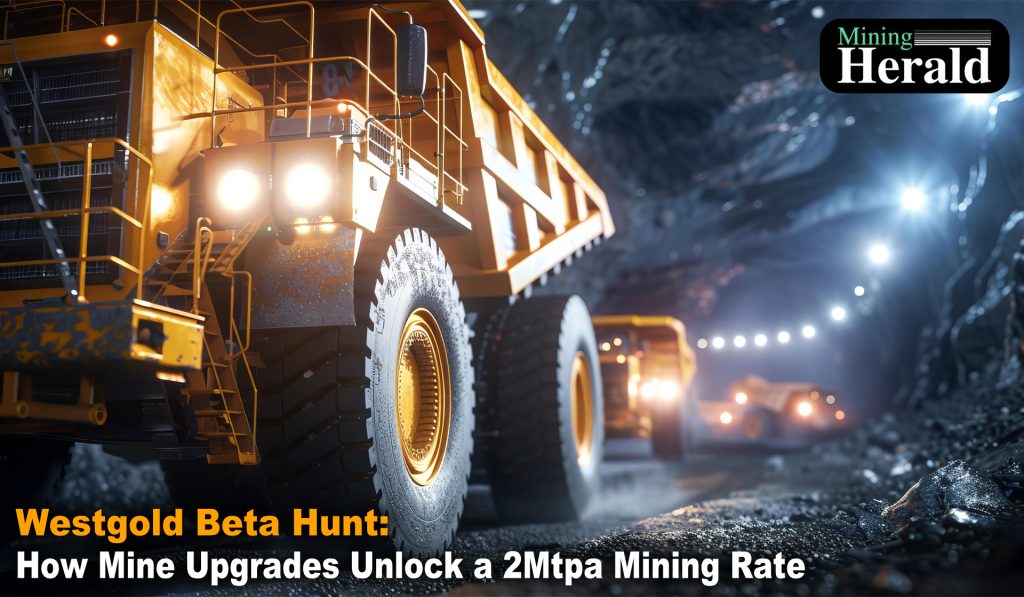
The Westgold Beta Hunt update, released on 21 October 2026, puts a series of infrastructure repairs behind the mine’s September performance.
Beta Hunt reached an annualised mining rate of 2 million tonnes during the month. Westgold is targeting consistent delivery at that level from Q2 FY27, covering October to December 2026.
September demonstrated the rate for one month. It does not mean the mine has already produced 2 million tonnes over a year.
Until being acquired by Westgold in August 2024, Beta Hunt had never achieved a mining rate above 1.4Mtpa. The company has since spent A$33.3 million on infrastructure to support a larger operation.

Figure 1: The underground portal at Beta Hunt in Kambalda. Archive photograph from 2018, before Westgold’s ownership. Credit: Kelsey Reid / The Kalgoorlie Miner.
Interim Fans Provide Airflow While Permanent Repairs Continue
Ventilation has been one of Beta Hunt’s main restrictions. The mineralised system extends for about seven kilometres, with roughly four kilometres developed.
Westgold installed a new primary fan station at the 801 level during FY26. Its two 1.7MW fans were designed to support the planned increase in mining activity.
Reliability became the problem.
Bearing and coupling failures limited output, forcing more mining into the upper parts of the operation. Additional bracing showed the system could support a 2Mtpa profile, but did not resolve the failures.
Westgold therefore installed an independent interim system. It was commissioned at the end of September, ahead of the planned Q2 FY27 timing.
The company says this system provides enough ventilation for approximately two years at the targeted mining rate. That gives it time to repair, recommission or replace the permanent fans.
September’s record rate was achieved before the interim system was commissioned. Its role now is to help make that performance repeatable.
Better Dewatering Keeps Roads and Work Areas Accessible
Westgold has rebuilt the network from active workings through to the surface discharge point.
The work included 12 secondary pumps, approximately 7.6 kilometres of pipework and three primary pumps at the 801 level. The rising main, previously the mine’s only discharge path, was also replaced.
Secondary dewatering works were completed in October.
These changes address a practical limit on output: a planned mining area contributes little if water prevents access to it.
Power Upgrades Remove a Risk to More Than Half the Mine
In early 2025, Westgold identified serious deterioration in the B6 feeder cable.
That cable supplied more than half the mine and the primary ventilation system. It ran through a ventilation rise exposed to salt and environmental degradation.
A failure could therefore have affected several parts of the operation at once.
Westgold drilled a new service hole and installed a secondary underground power feed, completing the work in May 2026. Surface upgrades included overhead lines, additional power banks and ring main units.
The Beta Hunt mine expansion consequently involves more than adding mining equipment. The services supporting that equipment have had to be strengthened as well.
| Infrastructure work | Reported investment |
| Permanent primary ventilation and associated development | A$10.3 million |
| Interim primary ventilation | A$7.4 million |
| Primary dewatering | A$2.5 million |
| Secondary dewatering | A$3.7 million |
| Water supply and services | A$1.5 million |
| Surface power | A$5.0 million |
| Underground power | A$2.9 million |
| Total | A$33.3 million |
The total includes the permanent ventilation installation, which still requires reliability issues to be resolved.
Mining Herald’s examination of growth across the ASX materials sector considers the operating work behind expansion plans.
A Revised Mine Layout Supports More Efficient Extraction
Westgold has also changed how Beta Hunt is mined.
More than 85 kilometres of diamond drilling over two years has improved geological information. CEO Wayne Bramwell said the work added more than 1.1 million ounces of reserves at approximately A$27 per ounce.
Better information has allowed the team to revise development layouts and mining sequences.
The decline network has been consolidated from four declines to three, reducing capital development requirements. Multi-lift open stoping is intended to reduce costs and material handling.
At Western Flanks, Westgold has adopted transverse mining methods following an assessment of the orebody. This requires more upfront capital but is expected to lower unit operating costs and improve scheduling flexibility.
Improved underground servicing and refuelling areas are due in Q2 FY27. Westgold says these are not required to reach 2Mtpa, although they should support reliability and lower costs.
More Ore Mined Will Initially Mean Larger Stockpiles
The next constraint is processing. Westgold says Beta Hunt is positioned to exceed Higginsville’s installed milling capacity, described as more than 1.6Mtpa. It intends to build mined ore stockpiles during FY27.
Those stocks serve two purposes: keeping the existing mill fully supplied and providing starting inventory for a potentially larger Southern Goldfields processing hub.
This distinction matters when assessing Westgold mining production. Grade, processing availability and recovery still determine how much gold is ultimately produced.
The relationship between multiple ore sources and processing capacity also features in Mining Herald’s Catalyst Metals Plutonic expansion coverage.
Fletcher Studies Will Define the Next Expansion
Seven underground rigs are working at Beta Hunt. Six are focused on reserve conversion at Fletcher, with one drilling resource extensions at Mason.
Integrated Southern Goldfields expansion studies are expected in Q3 FY27, covering January to March 2027.
The processing study is comparing two options:
| Development option | Scope being assessed |
| New processing hub near Beta Hunt | A 4Mtpa facility producing approximately 250,000oz annually, with existing Higginsville capacity taking combined regional milling capacity to about 5.6Mtpa |
| Expanded Higginsville hub | Capacity to treat 4Mtpa of Beta Hunt ore, supporting approximately 250,000oz annually |
These are study scenarios. Neither should be presented as an operating capacity already delivered or a final construction decision.
What to Expect Next?
Westgold has addressed several identifiable causes of lost production: unreliable airflow, insufficient pumping, poor water supply and vulnerable power infrastructure.
The next test is whether Beta Hunt can maintain September’s mining rate across successive quarters.
Investors should watch mined tonnes, grades, operating costs and stockpile movements together. Permanent ventilation repairs remain another checkpoint, even with the interim system providing operating capacity.
The Q3 FY27 studies will then show how Westgold proposes to connect further mine growth with enough processing capacity to use the ore.
ALSO READ: BHP Copper Mining: Production, Assets and Growth
FAQs
Q1. Has Beta Hunt produced 2 million tonnes in a year?
Ans. The announcement reports a 2Mtpa annualised mining rate achieved in September. Sustained performance is targeted from Q2 FY27.
Q2. Are the permanent ventilation fans fully operational?
Ans. Reliability issues remain. An independent interim system is operating while Westgold works on the permanent solution.
Q3. How much has Westgold invested in the listed infrastructure upgrades?
Ans. A$33.3 million across ventilation, dewatering, water supply and power.
Q4. When are the next expansion studies expected?
Ans. The integrated Southern Goldfields studies are expected in Q3 FY27.
Disclaimer
This post is for general guidance only and is not financial advice. Forward-looking mining targets, cost expectations and development scenarios are subject to change. Investors should read the company’s filings before making any investment decisions. Investing carries the risk of loss.
Filed under

About the author
Jonathon Brown
Jonathon Brown began his career as a broadcaster, working across markets in British Columbia before moving into financial journalism. Since 2017, he has specialised in stock market reporting, covering emerging companies across the healthcare, technology, mining and consumer sectors. He brings more than 15 years' experience to his reporting. A graduate of Vancouver Island University and the British Columbia Institute of Technology, Jonathon is focused on delivering clear, balanced reporting for investors.