


Key Takeaways
- 01 Capital discipline is reshaping commodity supply curves into 2026.
- 02 AI infrastructure capex is becoming a primary macro variable.
- 03 Central bank policy across AU, CA and US is converging on neutral.
A leach tank is only as good as its flow. Where solids settle, reagent does not reach, and metal stays in the tailings.
For metal recovery efficiency mining teams, that makes tank design a live question. Four studies published in 2026 now put numbers on it. One reports a plant trial. One models rare earth tanks. Two are reviews, covering nanobubbles and cavitation devices.
A Copper Plant Trial Shows What Flow Redesign Can Recover
Mohammadmahdi Kamyabi and Saeid Zandevakili investigated the use of computational fluid dynamics on an industrial leach column at the Sarcheshmeh Copper Complex in Rafsanjan, Iran. The unit treats refinery anode slime, not mined ore. According to the study in Hydrometallurgy, it runs eight-hour batches using sulfuric acid, air and steam.
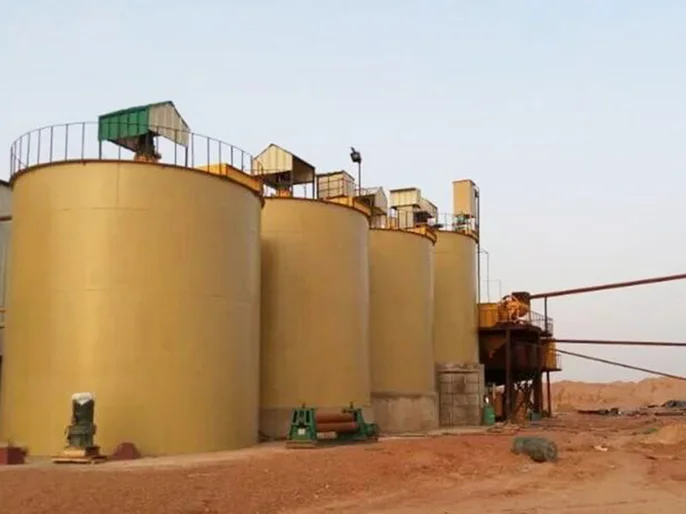
Figure 1: Agitated leach tanks at a mineral processing plant [Courtesy: JXSC Machinery]
Moving the Steam Inlet Reduced Dead Zones
The team tested five configurations. The best one turned the pulp outlet into a steam inlet. The authors report more uniform flow and fewer dead zones.
Plant sampling then showed residual copper in discharged tailings falling from 2% to 0.5%. The authors also report a copper recovery gain of 5 to 6% on site. They note that mass transfer was not directly simulated.
Baffled Elliptical Tanks Lead a Rare Earth Simulation
Dianyu E and colleagues examined the tank itself, a core part of leaching tank optimisation. Their study in the International Journal of Multiphase Flow, published in Apr 2026, models rare earth leaching. It couples one method that tracks solid particles with another that tracks the liquid surface.
The team compared four simulated tanks, each 190 mm in diameter. Flat or elliptical bottoms were paired with or without baffles.
| Tank design | Simulated behaviour |
| Flat bottom, no baffles | Deep vortex cores, particle layering, ion depletion zones |
| Elliptical bottom, no baffles | Grouped with unbaffled tanks, which showed inadequate leaching |
| Flat bottom, baffles | More uniform suspension and upward ion transport |
| Elliptical bottom, baffles | Best overall performance in the study |
The model is one ion only, and according to the authors it can be extended to multi-component leaching in subsequent works.
Nanobubbles Push More Oxygen Into the Leach
In oxidative leaching, oxygen needs to be present at the mineral surface.This step is key to a high metal recovery leaching process. Oxygen is not carried well by water, so oxidation slows. A paper in Minerals Engineering, dated 1 Sep 2026, looks at microbubbles and nanobubbles as a possible way to deal with this.
- Longer bubble life improves gas transfer, according to the review authors.
- Studies cited report faster leaching, shorter processing times and lower reagent use.
| Context | Reported result |
| Copper slime column, Iran | Tailings copper down from 2% to 0.5% |
| Zinc plant residue, oxygen nanobubbles | Copper 78% versus 52%, molybdenum 80% versus 70% without them |
| Nickel laterite, microbubbles | Nickel recovery 99.3%, cobalt recovery 89% |
| Refractory gold, cavitating jets | Recovery up 8 to 15 percentage points over agitation, as summarised by the 2026 review |
The nanobubble and nickel figures come from studies cited in the review. The gold range is the cavitation review’s synthesis of earlier work, not a new plant result.
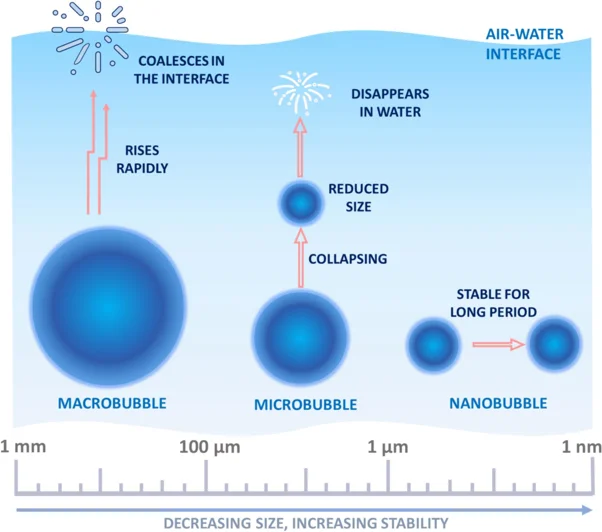
Figure 2: Macrobubbles, microbubbles and nanobubbles compared by size and stability [Courtesy: Laishram et al., Minerals Engineering]
Cavitation Gains Depend on the Bottleneck It Targets
Lorenzo Albanese of the National Research Council of Italy reviewed hydrodynamic cavitation in the journal Recycling, published on 3 Sep 2026. The paper synthesises earlier studies. It does not report a new plant trial. Its conclusion is cautious: cavitation suits use as a targeted module aimed at a verified process limit.
Earlier Jetleach Work Supplies the Gold Evidence
The Jetleach reactor was tested in earlier studies, which the review draws on. It impacts two pulp streams against each other inside a pressurised oxygen chamber.
The original Jetleach study reported a gold recovery gain of almost 10%. Cyanide demand also fell, and oxygen consumption fell by about 50% on a tailings concentrate.
Recovery improvements over standard agitation of approximately 8 to 15 percentage points were compiled in the review across refractory ores and tailings.
Attribution Remains Unresolved
The review notes that the Jetleach work lacked a non-cavitating impinging jet control at comparable mixing power. The gain cannot be credited to cavity collapse alone.
A local improvement does not necessarily translate into a whole flowsheet benefit unless it is able to survive the purification-product recovery process without the need for additional chemicals, water, energy or wear.
Limits That Operators Should Weigh Before Retrofitting
- Evidence base: One result is a plant trial. Another is a lab-scale simulation of single ion leaching.
- Cost and wear: Albanese cautioned that the benefits have to be not offset by an increase in energy, water, chemicals or wear of equipment.
- Retrofit: A retrofit solution involving redesign of the feed zones and gas distribution for existing flotation cells built to conventional bubble specifications.
Next Steps Rest on Plant Trials and Cost Data
Impact on recovery rates from tank and inlet changes remains to be confirmed beyond one site. The Iranian trial already ran at plant scale.
The nanobubble reviewers want a careful techno-economic check. Albanese calls for independent replication, representative feeds and full mass balances.
Until those arrive, headline numbers for metal recovery efficiency mining operations are research results, not plant guarantees. Mining Herald will track any trial that reports recovery and operating cost together.
ALSO READ: Africa Tightens Mining Control: What It Means for TSX and LSE Miners
FAQs
Q1. What is leaching tank optimisation?
Ans. It is the redesign of tank geometry, baffles, inlets or gas supply to improve contact between solids and reagent.
Q2. Which tank design performed best in the 2026 rare earth simulation?
Ans. The baffled elliptical bottom tank gave the best overall performance in the model.
Q3. Is the 8 to 15 percentage point gold gain a new 2026 result?
Ans. No. It is the 2026 review’s summary of earlier refractory gold studies.
Q4. Are nanobubbles ready for industrial leaching?
Ans. Not yet. The review describes industrial use as early-stage, with limited cost data.
Disclaimer
This article is intended for informational purposes only. If you pay attention to the mining and metals processing sector as an investor, then all the data in the content is from third-party sources. Please check out the complete share price and market data info. Investing carries a high risk, and you should only invest at your own risk. Mining Herald has no involvement in the above-listed Company.
Filed under

About the author
Jonathon Brown
Jonathon Brown began his career as a broadcaster, working across markets in British Columbia before moving into financial journalism. Since 2017, he has specialised in stock market reporting, covering emerging companies across the healthcare, technology, mining and consumer sectors. He brings more than 15 years' experience to his reporting. A graduate of Vancouver Island University and the British Columbia Institute of Technology, Jonathon is focused on delivering clear, balanced reporting for investors.