


Key Takeaways
- 01 ● The Company reported a new high-grade tungsten and gold zone at Apollo on 24 Sep 2026, yet the shares weakened.
- 02 ● The Company says it is funded for up to 90,000 metres of drilling in 2026.
- 03 ● Simply Wall St flags cost outcomes from future engineering work as the central risk.
Collective Mining Ltd. (TSX: CNL) reported a new tungsten and gold discovery on 24 Sep 2026. The find sits at the Guayabales Project in Caldas, Colombia. The Company also trades on Nasdaq under the same symbol. Yet the stock moved lower after the news.
Simply Wall St reported the decline. Neither its coverage nor the Company’s release explains the move. Any explanation of the selling is therefore interpretation, not confirmed fact.
Schist Discovery Gives Apollo a New Exploration Target
On 24 Sep 2026, Collective Mining reported assays from four diamond drill holes at the Project. One hole, APC150-D4, cut 8.15 metres at 14.82 g/t gold equivalent (AuEq). The interval starts 927 metres below surface. The interval includes 0.40% tungsten trioxide and 8.47 g/t gold.
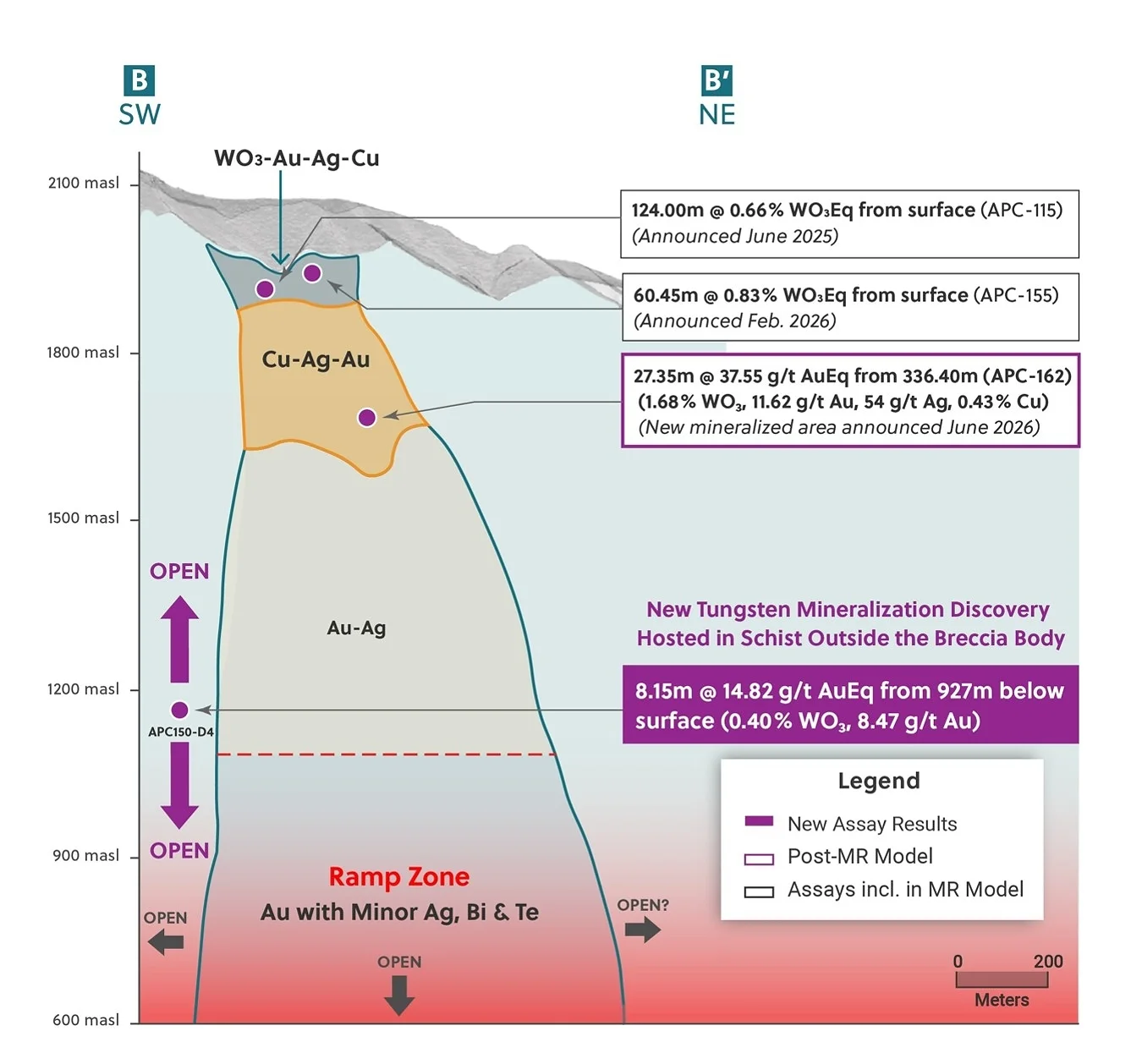
Figure 1: Drill core from hole APC150-D4 showing the new tungsten and gold style in schist [Courtesy: Collective Mining Ltd.
It is the Company’s first tungsten intersection in schist south of the Apollo breccia body. According to the Company, the hit sits about 680 metres vertically below the shallow tungsten zone in the block model. Little drilling has tested this schist unit, which runs deeper than 1,000 metres vertically.
Thirteen New Veins Lift Grade Inside and Beyond the Block Model
Mother hole APC-171D and two daughter holes found previously unrecognised veins, according to the Company.
- Thirteen new high-grade veins were identified.
- Seven lie outside the block model.
- Six sit within its southwestern margin, with grades above the modelled blocks.
- The best intercept was 1.15 metres at 57.98 g/t AuEq, including 55.50 g/t gold.
- A further 1.25 metres returned 28.73 g/t AuEq.
Table 1: Selected Intercepts Reported on 24 Sep 2026
| Hole | Interval (m) | Grade (g/t AuEq) | Depth below surface (m) | Position |
|---|---|---|---|---|
| APC150-D4 | 8.15 | 14.82 | 927 | Schist, outside breccia |
| APC-171D | 1.15 | 57.98 | 845 | Outside block model |
| APC-171D | 1.25 | 28.73 | 968 | Above modelled grade |
| APC171-D1 | 9.70 | 4.54 | 1,241 | Outside block model |
Executive Chairman Ari Sussman said the results open a new exploration opportunity beyond the breccia body.
Ramp Zone Step Outs and Pending Assays Keep the Story Open
Two holes, APC171-D1 and APC171-D2, extended Ramp Zone mineralisation about 35 metres west of the current block model. Both ended short of planned depth because of challenging ground conditions. The Company has since upgraded drill motor capacity.
Assays are pending for 17 Ramp Zone holes, with five more holes in progress. Visual observations, including localised visible gold, do not establish grade. About 470 metres of the 1.5 kilometre breccia circumference is now tested, against 315 metres in the maiden resource. The Company cautions that wider coverage does not by itself extend the resource.
Resource Base and Funding Frame the Valuation Debate
Collective Mining announced its maiden Apollo Mineral Resource on 8 Sep 2026.
Table 2: Apollo Maiden Mineral Resource
| Category | Tonnes (Mt) | Grade (g/t AuEq) | Contained AuEq (million oz) |
|---|---|---|---|
| Indicated | 37.0 | 2.17 | 2.58 |
| Inferred | 48.2 | 1.83 | 2.83 |
The Company reported US$93.7 million in cash as at 30 Jun 2026. It says this fully funds a 2026 programme of up to 90,000 metres. Thirteen diamond rigs are operating at Guayabales.
TSX Mining Exploration Risk Colombia Explains Why Traders Hesitate
Several documented factors give traders reason for caution. The sources do not tie any single one to the selling.
- Collective Mining has no revenue yet, according to Simply Wall St.
- Visual mineralisation in pending holes does not confirm grade.
- Two holes ended early, so the Ramp Zone target was not fully tested.
- The AuEq grades rest on assumptions. They use gold at US$3,000 per ounce and a 70% tungsten recovery rate.
- Simply Wall St warns that future engineering studies may push capital or operating costs higher than expected.
Wide Fair Value Gap Sharpens the Canadian Mining Stocks Valuation Decline Question
Simply Wall St’s narrative sets fair value well above current trading levels, as the share price table shows. That estimate rests on assumptions about Apollo’s resource growth and metallurgy. No source links the move to a wider sector sell-off. So any Canadian mining stocks valuation decline argument remains unproven for CNL.
Simply Wall St also highlights Apollo’s integrated processing flowsheet. The flowsheet shows how gold, silver, copper and tungsten could be recovered through separate dore and concentrate streams. The Company is aiming to support a 2027 licensing submission.
Share Price and Performance Data
| Metric | Data |
|---|---|
| Share price | CA$17.25 |
| Latest daily move | +0.759% |
| Move reported after the discovery | Down 5.4% (Simply Wall St) |
| 52-week high | CA$30.12 |
| 52-week low | CA$13.76 |
| Market capitalisation | CA$1,603,261,696 |
| Simply Wall St narrative fair value | CA$32.80 |
Next Assay Batches Will Decide Whether Confidence Returns
Collective Mining plans follow-up drilling to test the extent and continuity of the schist mineralisation. Assays for 96 holes remain outstanding, including 17 in the Ramp Zone.
The Apollo Mineral Resource is the first test, because only assays and further drilling can confirm growth. For CNL investors, results will either narrow or widen the gap between discovery news and trading. Mining Herald will track each assay release as it arrives.
FAQs
Q1. Why is CNL stock under selling pressure?
Ans. Simply Wall St reported a decline after the discovery. No source gives a confirmed reason.
Q2. What did Collective Mining discover?
Ans. High-grade tungsten and gold in schist outside the southern Apollo breccia body at Guayabales, Colombia.
Q3. Is the Company funded for 2026 drilling?
Ans. Yes. It reports US$93.7 million in cash as at 30 Jun 2026 and funding for up to 90,000 metres.
Q4. What are the main risks?
Ans. Pending assays, holes ended early, assumed metal prices and possible higher engineering costs.
Disclaimer
This article is intended for informational purposes only. If you pay attention to the gold mining sector as an investor, then all the data in the content is from third-party sources. Please check out the complete share price and market data info. Investing carries a high risk, and you should only invest at your own risk. Mining Herald has no involvement in the above-listed Company.
Filed under

About the author
Plamen Vasilev
Plamen Vasilev is a writer and language specialist with over 6 years of experience developing informative and engaging content across multiple industries. He combines strong research skills with a deep understanding of finance, mining, technology, and business topics to create well-crafted articles that connect with readers.