

Key Takeaways
- 01 Capital discipline is reshaping commodity supply curves into 2026.
- 02 AI infrastructure capex is becoming a primary macro variable.
- 03 Central bank policy across AU, CA and US is converging on neutral.
Australian mining operators reported production data demonstrating throughput gains of 14 percent across processing plants without purchasing crushers or mills. The performance records confirm that software platforms deploying circuit intelligence extract mineral concentrate from comminution circuits. Production logs from pilot operations show throughput increases of 14.2 percent across grinding mills and flotation circuits.
Mining technology consortium METS Ignited and mineral processing engineers released the plant benchmarking report in Perth. The document details how computer models and sensor arrays stabilise ore feed variations across autogenous grinding circuits.
Mining facilities allocate hundreds of millions of dollars in capital expenditure to expand plant output capacity. This operational transition replaces plant expansions with data analytics and real-time supervisory process control. Mineral processing plants unlock capacity by running machinery closer to design limits without triggering shutdowns.
The architecture integrates edge sensors, acoustic monitors on grinding mills, and machine learning models. These tools calculate rock breakage parameters continuously and alter water addition rates inside the mill shell within milliseconds.
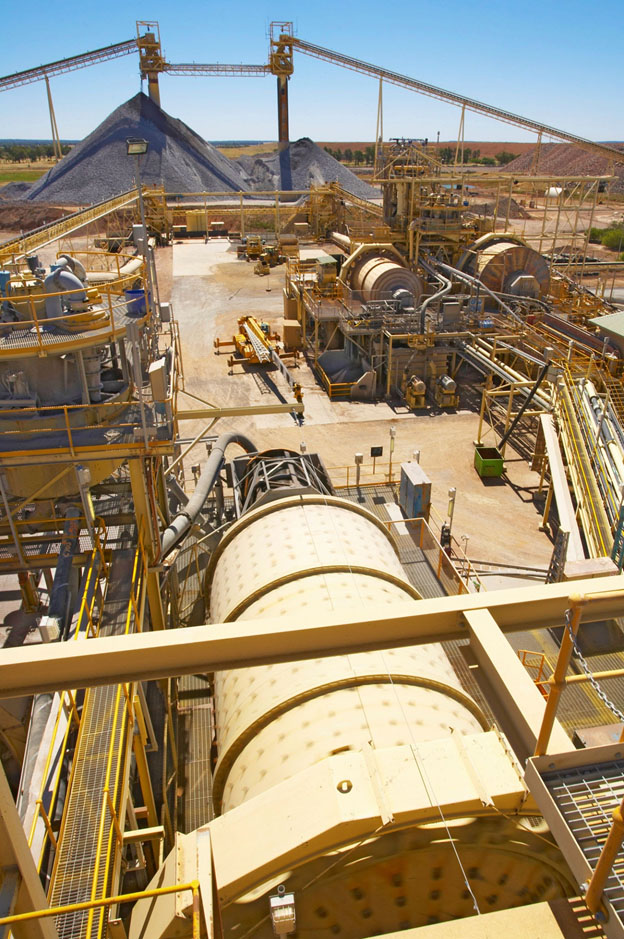
Grinding mills and conveyor feed circuits represent the most energy-intensive comminution stages targeted by circuit intelligence [Alfio Manciagli / Getty Images]
The Big Picture: Squeezing More Value from Declining Ore Grades
Resource companies confront grade decline across mining jurisdictions alongside rising power tariffs and water restrictions. Grade dilution forces companies to mill more rock to produce target quantities of copper, nickel, and gold. Processing plants consume 3 percent of global electrical energy, and comminution circuits account for 50 percent of mine electricity demand.
Circuit intelligence directly lowers energy consumption by 8.5 kilowatt-hours per tonne of milled ore. These efficiency gains reduce carbon emissions and power bills across mine sites that rely on diesel fuel generation or island grids.
Investors and communities track mining performance because resource extraction generates export revenue and state royalties. Yield increases without capital expenditure preserve balance sheets and protect shareholder capital from construction cost blowouts. Process stability restricts tailings dam volume growth and conserves water supplies.
Site workers gain safety protections because automation removes manual sampling tasks around flotation cells and rotating machinery. Maintenance teams schedule component replacements using wear predictions rather than responding to equipment breakdowns.
Key Players: Industry Giants and Tech Innovators Joining Forces
Organisations across the resources sector lead the deployment of circuit intelligence systems. Mining companies BHP, Rio Tinto, and Fortescue conduct field trials alongside technology vendors Weir Minerals and Metso. The Commonwealth Scientific and Industrial Research Organisation provides metallurgical data modelling alongside software developers.
METS Ignited Chief Executive Officer Adrian Beer endorsed the trial results during the industry briefing. “Technology companies deliver productivity gains to mine operators by eliminating processing bottlenecks with mathematics rather than concrete,” stated Beer.
- Engineers from Weir Minerals implemented acoustic sensors and vision algorithms across processing plants in the Pilbara region. The systems predict slurry pump impeller wear and correct hydrocyclone pressure deviations.
- The Australasian Institute of Mining and Metallurgy compiled performance data across copper concentrators and zinc facilities. Institute data confirms that process automation reduces slurry variability across flotation cells by 23 percent.
- Plant metallurgists and control room technicians operate the supervisory systems through telemetry dashboards. Technicians retain oversight while computer algorithms execute mill speed changes and reagent dosages.
University research groups, including the Julius Kruttschnitt Mineral Research Centre at the University of Queensland, developed the rock breakage kinetics models. Academic researchers validated algorithm calculations against core drill samples from mining tenements across Queensland and New South Wales.
Ground Zero: Transforming Operations Across Global Mining Hubs
The initial deployments occurred across processing facilities in the Pilbara region of Western Australia and the Bowen Basin in Queensland. Mineral processing plants in these regions confront ambient temperatures above 45 degrees Celsius and power grid limitations. Production teams at copper-gold mines in central New South Wales also incorporated the circuit intelligence software into autogenous grinding flowsheets.
Western Australia serves as the primary testing ground for resources automation due to the production scale of iron ore and lithium assets. Technology teams in Perth communicate with site staff in Newman, Port Hedland, and Kalgoorlie through remote operations centres.
International operations in the Atacama Desert in Chile and the Copperbelt in Zambia adopted the Australian control architecture. Mining houses install these sensor suites across overseas processing hubs to unify plant standards.
Timeline & Milestones: From Trial Runs to Full-Scale Rollout
The consortium commenced site trials in March 2025 across Western Australian comminution plants. Engineers completed sensor calibration protocols in November 2025 following continuous baseline measurement campaigns. METS Ignited published audited performance data on Thursday.
Commercial installation programmes expand across Australian mine sites during the final quarter of 2026. Resource houses target complete telemetry integration across twenty-four processing hubs before June 2027.
Mining industry leaders will convene at the Global Mining Technology Conference in Brisbane next month. Metallurgical teams will present plant data and continuous production logs during the technical sessions.
Key Takeaways
- Circuit intelligence software increases mineral processing throughput by 14 percent without requiring multi-million-dollar physical plant expansions.
- Algorithmic process control reduces grinding mill electricity consumption by 8.5 kilowatt-hours per tonne of ore.
- Continuous sensor monitoring and automated control loops safely push mills to 98 percent motor capacity while detecting blockages up to ten minutes in advance.
Under the Hood: How AI, Sensors, and Real-Time Data Optimize Operations
The transition to circuit intelligence relies on continuous data acquisition and automated physics modelling. Sensors measure rock dimensions on conveyor belts before material enters primary crushers. Microphones record rock impact sounds against mill liners to calculate internal charge volume and grinding media trajectories.
The supervisory software ingests 1,200 data points per second from instruments across the grinding circuit. The algorithm detects plant choke conditions ten minutes before blockages occur in transfer chutes or cyclones.
- Vision cameras track rock sizing on feed belts to measure fragmentation variations. The software alerts blast engineers when rock dimensions exceed threshold limits.
- Dynamic control loops adjust slurry pumps and water valves across hydrocyclone clusters. These interventions maintain pulp density and prevent oversized rock particles from entering flotation banks.
- Automated reagent dosers deliver chemical collectors into flotation cells based on mineral surface readings. Sensors evaluate froth velocity and bubble diameters to stabilise mineral recovery.
Processing plants routinely record production losses because operators maintain conservative mill speed margins to avoid downtime. Circuit intelligence removes these operating buffers by balancing mill feed dynamics against ore hardness variations. Grinding mills consequently run at 98 percent of motor power capacity throughout entire shifts.
Technology providers will expand algorithm functionality into secondary crushing circuits and tailings filtration plants during coming months. Miners will connect plant intelligence platforms directly to open-cut dispatch systems to match mine face extraction rates with mill capacity.
Filed under

About the author
Jonathon Brown
Jonathon Brown began his career as a broadcaster, working across markets in British Columbia before moving into financial journalism. Since 2017, he has specialised in stock market reporting, covering emerging companies across the healthcare, technology, mining and consumer sectors. He brings more than 15 years' experience to his reporting. A graduate of Vancouver Island University and the British Columbia Institute of Technology, Jonathon is focused on delivering clear, balanced reporting for investors.